

Happy July, my nature-loving friends. Ken Hall, aka Bird Nut, here. Halfway through 2026. Where the heck did May and June disappear to?
An amazing spring if you are a nature lover such as I. Badly needed rain in May has turned a sepia-toned world into a sea of green and shut down the gloom-and-doom news channels warning us that any day we’ll be drinking bath or toilet water. Not to make light of what is the driest winter I remember in my older-than-60, younger-than-80 age, but with those milder temperatures, migrating birds found their way back to Colorado unimpeded by weather in record numbers.
I have never seen a spring so full of feathered life. Now, as we zoom into summer, we can easily see the results of an amazing nesting season. A short wander—or just a bit of bench time—in one of our many parks will improve the spirits of even the grumpiest of souls.
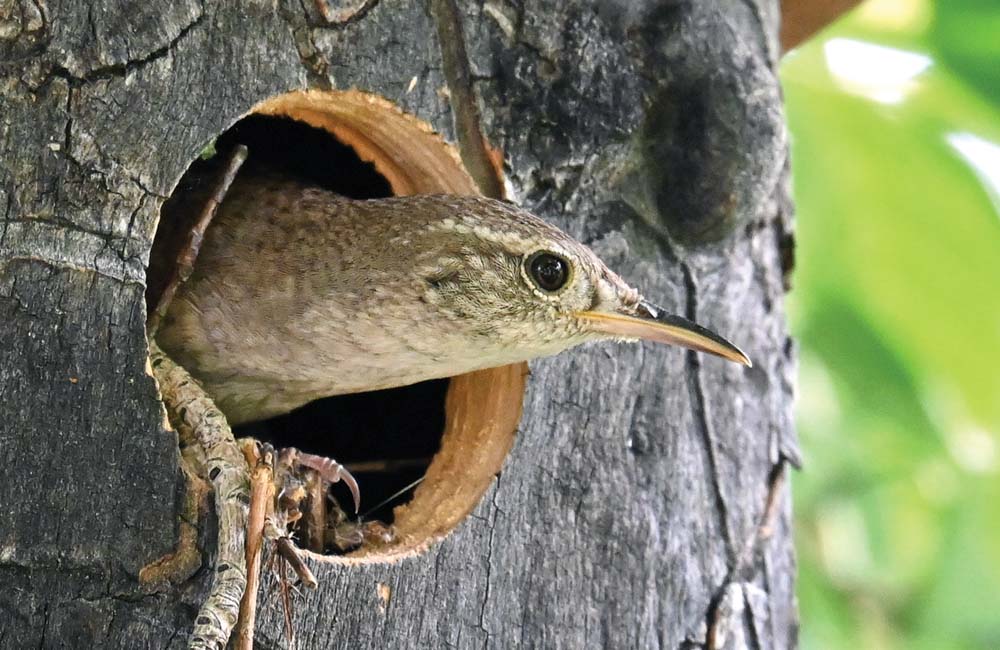
Staying with my Bird Nut label, I would like to share some fascinating facts about one of our tiniest migrators: the house wren, weighing no more than a couple of quarters. They arrive in Colorado in March after wintering in the southern United States and Mexico for mate selection and nesting. They typically head back south in late summer or early fall.
July is a great time to meet these little ones and their youngsters, or at least hear them. I have been asked many times what type of bird is singing that happy little tune. I’ll point out a hyper little brown blur skittering about under shrubs, never holding still while it finds spiders and other delectable delights.
House wrens are tiny in stature, not in attitude. Beautifully marked in various shades of brown, they have a striped short tail that is always pointing upward unless threatened. They have long, pointed beaks perfect for probing nooks and crannies for insects. They are meat eaters. I have never seen one at my feeders.
Their song has always brought a smile to my face. They sing a happy little song—or so I thought. Having to forgo chores for this article’s research, I have spent much time trying to understand their music. What I thought was one happy little song is actually many little songs. Researchers say a wren can sing up to 600 songs per hour. It may sound the same, but a slight change in cadence or inflection can take on totally different meanings.
In March, they announce their arrival with an “I’m needing me a woman” love song while getting busy finding five to six possible nesting sites. Not only do they find them, but they prepare them for inspection. Since wrens are cavity nesters, meaning they nest in holes in trees, they look for abandoned woodpecker holes or naturally occurring cavities. If those aren’t available, they may seek out other hidden possibilities. They have claimed boots left on the back porch, rain gutters, and even discarded cans.
The male will load these possibilities with a haphazard pile of sticks. But even this has a purpose. They create stilts. If the chosen female says, “I like this place, honey,” she will build a soft nesting cup on top of the sticks, elevating the nest pocket in case of water. The male also loads these sticks with spider egg sacs. The spiders hatch and eat nest lice and fleas. The spiders then grow and are eateBy the nestlings. The male has already put a lot of work into this and, hopefully, wins the heart of a maiden.
When all is settled, the female is busy furnishing while the male finds a nearby limb, fence, or tree and sings his no-trespassing song. Again, it sounds the same to me. If something trespasses, these tiny little birds become lions, scaring off interlopers ten times their size. I know—they try to scare me off.
I created a nest box from an old fallen log whose center core had fallen out, leaving it hollow. I drilled a hole, squared the top and bottom, and added a roof and floor. The perfect nest box. But I learned in the past that a home is only as good as its location. I placed it on a wooded fence post in heavy foliage, away from my feeders and other birds. It worked. They now have nestlings.
Both parents are busy from sunrise to sunset feeding five to seven babies. At this point, while one gathers food, the other stays close, singing and guarding. The young grow quickly. One week after fledging, the female will likely find a new mate and have a second clutch. For some reason, she’s tired of the first mate.
Fascinating little birds and among my favorites of spring and summer. The next time you’re wandering through one of our parks, listen for what seems like a repetitive sweet song. Then watch around ground clutter for these tiny, adorable little birds with lion hearts seeking out a meal. A lot of fun and quite challenging to observe.
Hope to meet you out there somewhere. God bless.
Follow my photos on Facebook: Bird Friends of Colorado and Birds of Colorado.