

Happy August, my nature-loving friends! Ken Hall here, aka the Bird Nut. If the heat is breaking you down as it does me, we can look forward to only 146 days until Christmas!
July was a tough one unless you grew up in the desert. Most of my nature walks happened during the first three hours of the day. But our weather experts say cooler temperatures and more moisture are coming. Bring it on!
I’ve often said, “If it has wings and doesn’t bite or suck my blood, I’m loving it.” So, this month, I’m changing things up. The Bird Nut is becoming the Wing Nut. A wing nut can describe someone who’s slightly unhinged or an eccentric personality — both descriptions those who know me would probably agree with!
For several years, my Sis and I have gone on weekly wanderings, usually along the greenbelt. She puts up with my frequent stops to stare into the trees or my sudden detours through weeds and poison ivy when I see something move.
One of my favorite things to photograph in August is bees and butterflies. As milkweed, rabbit brush and fall flowers bloom, they attract plenty of nectar-seeking beauties.
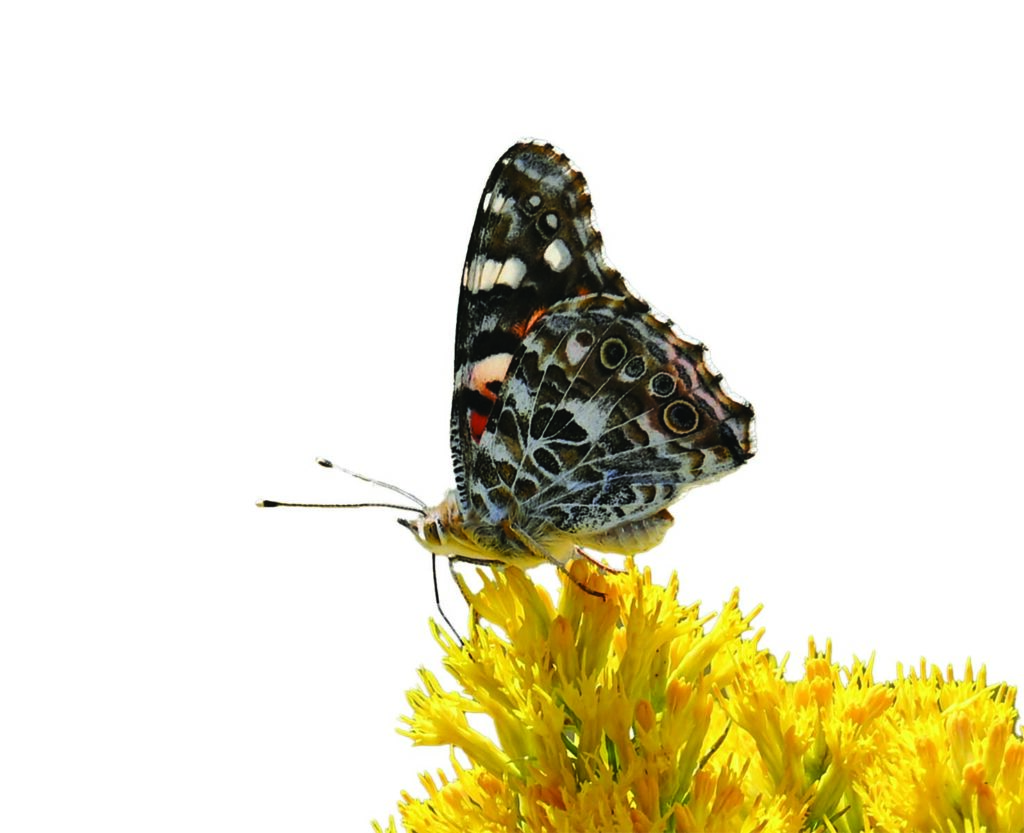
This month, I’m talking about one of my favorites: the Painted Lady. Not the two-legged variety, but the beautiful butterfly we see nearly every time we’re on the trail.
Painted Ladies are about 2 to 2½ inches from wingtip to wingtip. Their upper wings are bright orange with black edging and white spots, while the undersides are brown with small white and orange markings.
Painted Ladies have a close cousin, the American Lady. A quick way to tell them apart is by looking at the underside of the wings. The Painted Lady has four distinct eyespots in a row, while the American Lady has two less-distinct eyespots.
Now for the wow factor: Painted Ladies are capable of incredibly long migrations. Some populations travel thousands of miles between Africa and the Arctic, with several generations completing the journey. They are also among the fastest-flying butterflies, reaching speeds of 20 to 30 miles per hour.
Their adult lifespan is short, only about three to four weeks. Add another three to four weeks for their development from caterpillar to adult, and their entire life cycle is only about eight weeks. During that time, females can lay approximately 500 eggs.
Painted Ladies begin leaving Colorado in late August and early September. Their caterpillars feed on a variety of plants, including milkweed, and can store toxins from those plants in their bodies, making them less appealing to predators.
So, the next time you’re out for a wander, keep an eye out for these beautiful little creatures. If you see someone running aimlessly through a meadow, it will likely be me in pursuit of a gorgeous butterfly!
Hope to see you on the trail!
You can follow my photos on Facebook at Bird Friends of Colorado or Birds of Colorado.
God bless!