

Happy May, my nature-loving friends. Ken Hall, aka Bird Nut, here. Five months into the new year—wasn’t it just Christmas?
For a bird lover such as I, May is the closest you can get to bird-watching heaven. With many migrating birds having already returned in April, May is the frosting on the cake. Tanagers, warblers, orioles, and many others make their appearances known in brilliant colors, beautiful songs, and amazing breeding displays.
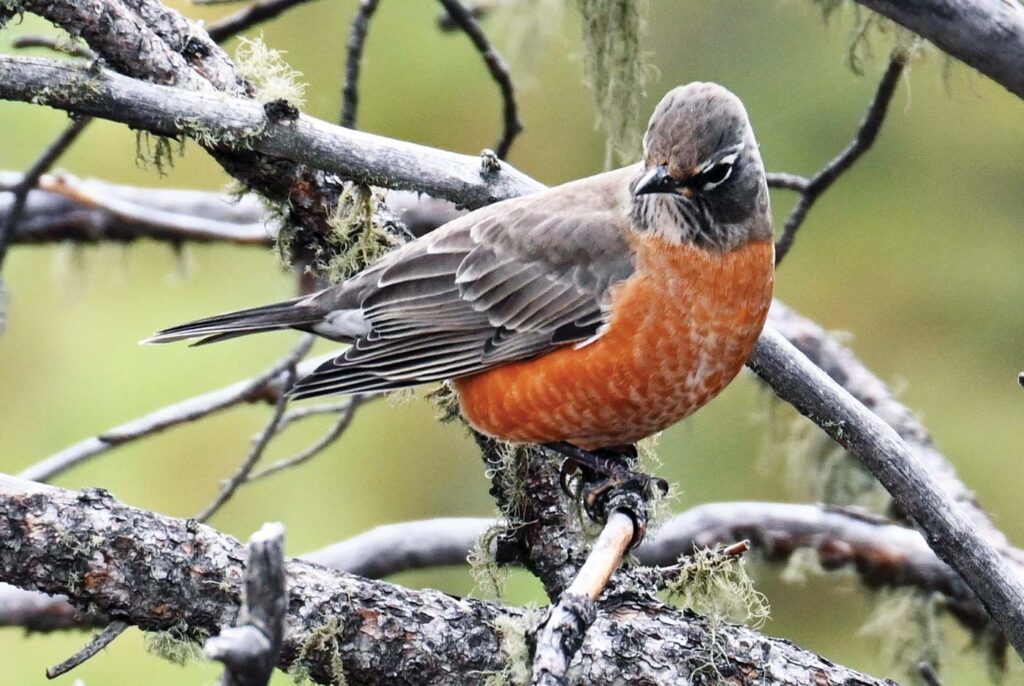
So you would think I should write about these birds. But knowing that thousands of photos will be posted to social media of these part-time residents, I chose to write about a year-round, quite common songster: the American robin. That predawn opera singer that I personally love hearing at 5:00 a.m.
Loving to write about birds, and nature in general, I am humbled at times by just how little I know. I have learned some fascinating things about these beautiful members of the thrush family. There have been extensive studies done on robins. None of this information is AI-generated.
I’ll start with their predawn song, “cheerily, cheer up.” Some people complain about the happy-sounding tune disrupting their sleep. Not this guy. It is a happy sound to wake up to—the song that announces spring has sprung.
I always thought it was their celebration of life and another day. Actually, the song serves a couple of purposes. Why so early? Dawn brings calmer air, less wind, and lower noise pollution. Robins use the song to establish or defend territory. It can also be used to attract mates.
They have exceptional eyesight and light sensitivity. So what is still darkness to us is the start of a new day for them. My dad used to hear a robin singing midday and believed it was announcing rain on the way. For the same reasons listed above, the prediction was often correct. Barometric changes carry their songs farther.
Most folks have watched robins hunting worms, sometimes caught up in a tug-of-war with a snake-sized nightcrawler. I will forever be amazed at their skill and success in hunting worms.
I believed it was all from their feet to legs to brain. I was wrong. Robins have eyesight three to four times stronger than that of average humans. They have monocular vision, with eyes set wide on the head, giving them a 340-degree view of the world.
When watching them hunt, they tilt their heads and use one eye—usually the right eye—to look for the slightest movement. Most robins are right-eye dominant, while the other eye watches for danger from above.
Another remarkable design is their hearing. They can actually hear a worm moving beneath the soil, helping them better pinpoint the target. When all else fails, they combine vision, hearing, and feel to increase the odds of adding a worm to their breakfast menu.
Because we notice them more in the spring, it’s easy to think they are returning from migration. Not true. When the ground has frozen, they move in quite large groups to nearby areas overgrown with trees and shrubs, always near water.
Their winter diet becomes mostly fermented berries left hanging from summer. Because these berries ferment over time, robins can and do get a bit tipsy. That is why water is so important—it flushes the alcohol more rapidly through their systems.
Often you will see these large groups partying alongside cedar waxwings. It’s fun to watch. About 60 percent of a robin’s diet consists of berries.
Another fascinating aspect of a robin’s vision is magnetoreception, the ability to actually see the Earth’s magnetic field as patterns of light and shade or color. This allows them to navigate with extreme precision.
Since much of this writing focuses on a robin’s ability to catch worms, I’m going to talk about worms.
Robins have been around for thousands of years. In Colorado, worms have not. This was something else I learned while researching for this article. The worms we see in our gardens are not native to Colorado.
Glaciers scoured the earth, completely wiping out worms and nightcrawlers. Worms were reintroduced within the last 150 years by humans, mostly from Europe. Some were brought intentionally to improve garden soil; others arrived in imported plants and trees.
After verifying this through many sources, I became curious how a worm could end up under a rock in the middle of the wilderness. The explanation is that they were brought there by fishermen. Laying thousands of eggs, with few predators, worms spread exponentially.
It sounds like a far-fetched story, but I speak the truth. Robins lived a long time without worms being part of their diet. But when worms showed up, robins were already prepared to take advantage of this delectable delight.
So take a moment to pause the next time you see a robin. They are nature’s engineered wonder in the world of birds.
Follow my photos on Facebook at Birds of Colorado and Bird Friends of Colorado.
Hope to meet you on the trail. God bless.