

Happy September, my nature-loving friends. Ken Hall, aka Bird Nut, here.
For many young folks, August is the beginning of a new school year. That holds true in nature as well. A new generation has emerged. Since I’m the bird guy, the generation I speak of wears feathers.
The parent birds have worked tirelessly to raise their kids to the point of leaving the nest. But that effort is only the beginning. Now they have multiple children in multiple places to protect and feed. Just because the youngsters are now nearly the size of an adult doesn’t change a thing when it comes to their neediness.
The parent birds must teach the kids to feed themselves, fly with some form of grace and recognize danger. This can take anywhere from weeks to months.
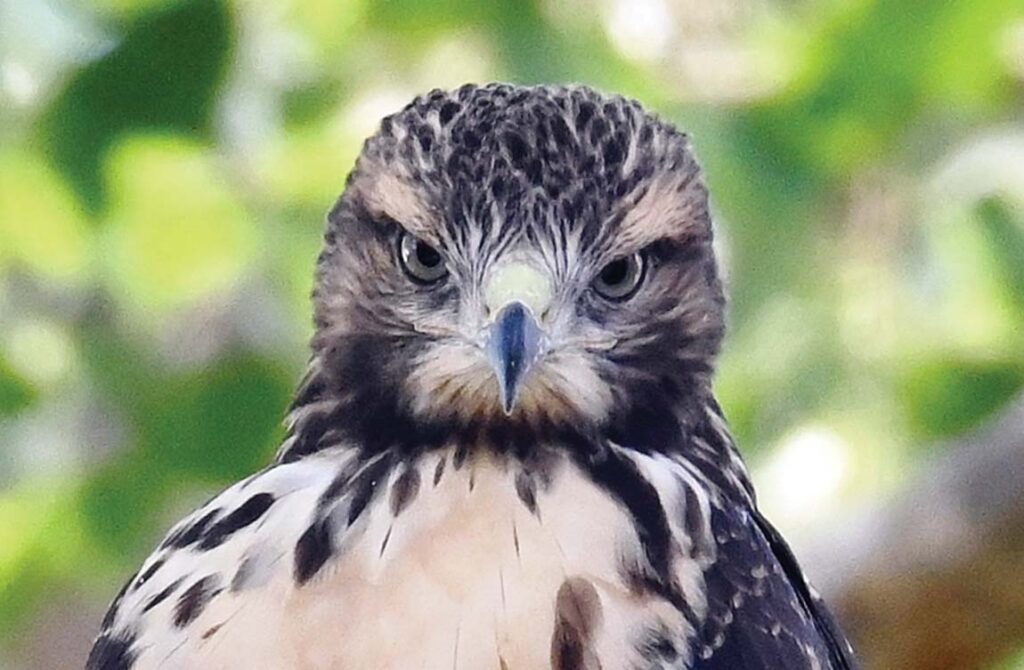
The bird I wish to write about this month is the red-tailed hawk. I have had the good fortune to witness the same pair for five years. They have returned to the same nest each year. This nest happens to be in my backyard. All but one year, they have had successful nestings. We have two more youngsters out here again this year.
The kids are now nearly as big as their parents. They have graduated to what is called branching. They will hop from the nest onto nearby branches, where they have more room for hawk aerobics. They stretch and flap their wings, studying the new world around them while patiently waiting for Mom or Dad to bring food.
When the young first leave the nest, they stay very close, making it relatively easy for the parent birds to find them. But after a week or two, they expand their branching explorations. Still unable to fly, they jump from limb to limb, and the siblings don’t stay close to one another. This makes it really tough for food delivery.
The parent birds will announce incoming food with a very loud scream. The young will reply in a soft, high-pitched chatter. But it is loud enough for the parents to find them.
I might add that the scream of the adult red-tailed hawk is the loudest of all raptors. It is quite often used by Hollywood as the call of an eagle.
The youngsters, with each passing day, are getting stronger and closer to flight. This process can take up to four weeks.
Adult red-tailed hawks are fantastic parents. While one hunts, the other will be in a nearby tree, keeping an eye on the kids.
Red-tailed hawks are large, powerful birds that are deceptively fast for their size. They have actually been used by falconers in place of hard-to-find falcons. They are capable of diving at speeds of up to 120 miles per hour. Their eyesight is eight times that of an average human. They are able to spot small prey from 100 feet away.
They are versatile hunters. Mice, squirrels, rabbits, snakes and other small rodents make up the majority of their diet. The classic red tail feathers will not show their cinnamon-red coloring until their second year. Juveniles sport a brown-barred tail.
The young, not yet capable of taking larger prey, will ingest insects — lots of insects — during their first six months.
In the wild, red-tailed hawks can live as long as 20 years, with an average lifespan of eight to 10 years. They mate for life, unless one dies. Then the living mate will stay close to its territory, waiting for its lost mate to return. It’s sad to watch.
The now-widowed bird will eventually head out looking for a new mate.
Three years ago, the female of the original pair here was found dead at the base of their nesting tree. It could have been from a collision with the tree. The male continued to update the nest, hunt the area and stay until fall. The last I saw him that year, he was soaring through the sky with a newfound mate. I knew by his coloring that it was him when he returned with his new mate the following January.
Lastly, the red-tailed hawks we have in Colorado will not migrate over the winter. So, virtually any month of the year, you may see these beautiful birds riding the wind currents.
One of nature’s greatest designs.
You can check out my photos on Facebook at Bird Friends of Colorado or Birds of Colorado. Hope to meet you on the trail. God bless.