

The 38th Avenue corridor is the heart and main street of Wheat Ridge and as the community prioritizes safety, engagement, placemaking and identity, the challenge becomes balancing these long term goals with the everyday needs of the current businesses and their customers. At the city council meeting on June 15th, a refresh of 38th Avenue between Wadsworth and Sheridan boulevards was proposed, which has been an ongoing topic of discussion, spanning two decades.
The effort to reshape 38th Avenue dates to the city’s 2005 Neighborhood Revitalization Strategy and 2009 Comprehensive Plan, which envisioned the corridor as a pedestrian-oriented main street. The 2011 Corridor Plan led to the 2012 “road diet,” reducing the street from four travel lanes to three while adding a center turn lane, bicycle lanes and on-street parking. Supporters viewed the changes as safer and more walkable, while opponents raised concerns about traffic flow and business access.
A permanent improvement plan developed in 2013 and 2014 did not move forward. Since then, the corridor has changed incrementally through redevelopment, rezoning, streetscape improvements and the opening of outdoor venue The Green on 38th at 7101 W. 38th Avenue in 2025.
Ballot measure 2J, approved in 2023, extended the city’s existing half-cent sales tax and provided $10 million for the proposed refresh.
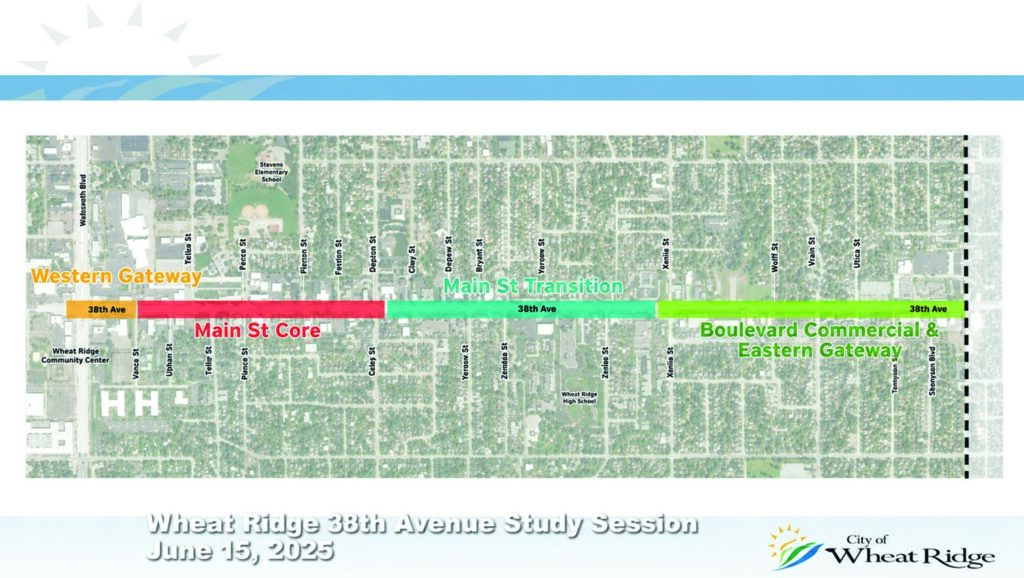
The preliminary design discussed at the recent city council meeting divided the corridor into four sections: the Western Gateway, Main Street Core, Main Street Transition and Commercial Boulevard and Eastern Gateway, which may lead to a phased approach.
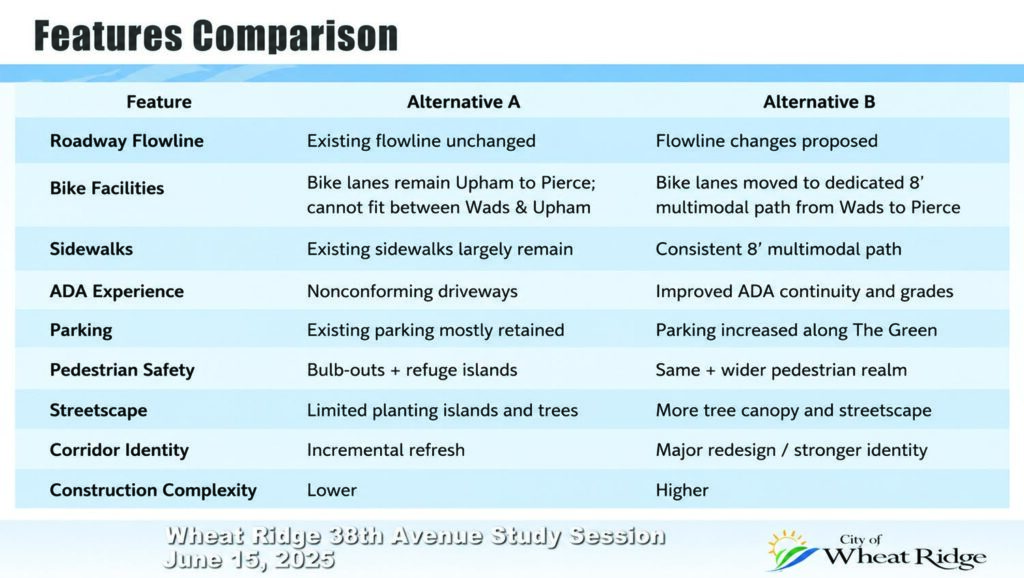
Two preliminary concepts were reviewed that illustrated the range of possibilities of features, with neither plan intended to be the final design. A is the lower-complexity approach that would add bulb-outs and pedestrian refuge, but would largely be similar to what exists today and would not change the flowline, bike lanes, sidewalks or increase parking. It would cause less disruption but it would leave some of the existing concerns including sidewalk width. Whereas option B would add an 8-foot multi-modal path, increase parking along The Green, increase American Disabilities Act (ADA) accessibility and add space for placemaking, possibly including additional patio space for businesses, but would require the flowline to change, which would increase the construction complexity.
“We invite the community to have these trade off discussions,” said Community Development Director of Wheat Ridge Lauren Mikulak. “Would they rather have construction and an 8-foot multi-modal path or minimal construction, even though the sidewalk varies in width?”
Council members found reasons to support and question elements of both approaches.
Council member Scott Ohm said he favors safety measures, expanded patios and landscaping but does not support the proposed multimodal path.
“As a cyclist, I would avoid it altogether,” Ohm said.
Council member Mike Okada questioned how medians and flow-line changes could add time and complexity to construction. Council member Dan Larson said that although the refresh is part of the 2J program, the city must get the scope right before committing a significant amount of taxpayer money.
Many factors will comprise the final plan. Other construction priorities arose including city council member Jenny Snell’s safety concerns as she referred to making a right turn at the intersection at 38th and Teller as “taking your life in your own hands.”
To inform other safety measures and decisions, staff tracked school-year counts recorded peak periods with as many as 15 bicyclists and 45 pedestrians along the corridor.
A separate, grant-funded safety project is planned at 38th Avenue and High Court near Stevens Elementary. It would install a pedestrian-activated HAWK beacon, enhance crosswalk markings and add a median or pedestrian refuge island. Staff said that project will move forward regardless of the broader corridor plan.
The Wadsworth Boulevard reconstruction reached substantial completion in December 2025 after years of lane changes, detours and difficult access. Concerns were raised about the orange-cone fatigue felt by residents and the businesses they support and the risk of diverting traffic but owners also see the long-term vision.
Spencer Frame, owner of Wheat Ridge Lanes at 6595 W. 38th Avenue said that he has mixed emotions because he is concerned about the business impact but he also said,“I would support the idea of improved pedestrian traffic and aesthetics.”
Assistant manager of Little Brazil at 7333 W. 38th Avenue, Liza Pereskova, echoed the open-minded sentiment saying that yes, the Wadsworth construction was a challenge, but as it relates to the 38th corridor, “It’s for the best that the area is developing. In Brazilian Portuguese we say ‘faz parte’ or ‘it’s all part of it,’” she said.
Stites said the city has time to work through any concerns.
“We’re talking roughly a year and a half to two years before a shovel hits the ground, and so there is time for businesses to recover from Wadsworth,” he said.
He also pointed to the central lesson of the road diet debate and how the approach will change to be business-centric.
“As somebody who led the fight against the first road diet, not engaging the businesses was the biggest mistake made at that time,” Stites said.
The businesses have changed dramatically, but earning buy in and keeping owners informed remain essential, he said.
Neighborhood Engagement Specialist Ashley Holland said outreach will include public engagement and direct conversations with those most affected.
“Any property owner or business that will have a high impact where there are proposed changes to parking, access or landscaping will be addressed through targeted conversations either one-on-one or in small groups,” Holland said.
The study session ended with council direction to continue gathering feedback and no construction plan has been approved at this point.
For residents wondering about the ornamental clocks, staff said repairs remain on the roadmap, but not until the final aesthetic phase.
“As elected officials, our responsibility is to listen to our community and follow through on the commitments we made to voters while working with businesses to ensure the best possible results,” Mayor Korey Stites said in a statement. “The project is about investing in a safer, more vibrant Main Street that will serve residents, businesses and visitors for decades to come.”