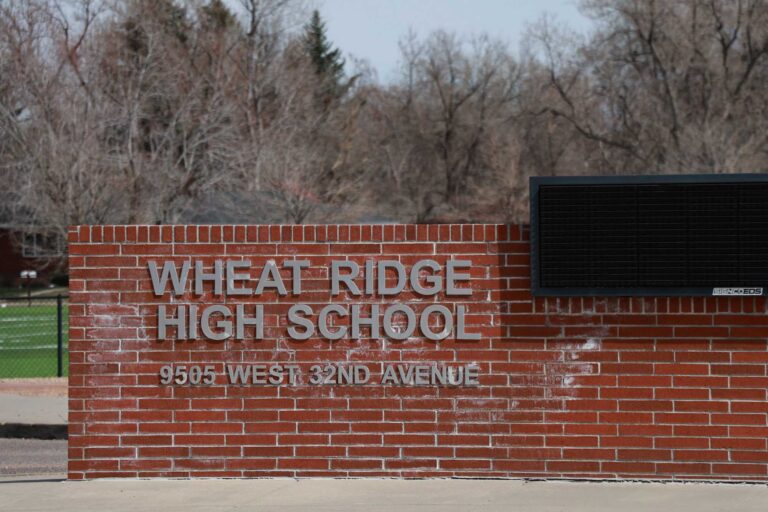


More than 1.4 million American students left traditional public schools between 2019 and 2023. Wheat Ridge has been no exception to this trend, as evidenced by closing schools and declining enrollment in recent years.
Across Wheat Ridge and Jefferson County, families are increasingly choosing charter schools, homeschooling, and private education over traditional public schools. Susan Miller witnessed this shift firsthand during her time on the Jefferson County Board of Education from 2019-2023. During that time, 23 schools closed, and the district went through three different superintendents. “It was a busy time,” Miller says.
In Colorado, traditional public school enrollment has dropped by about 10,000 students, or 1.2%, in the past year, while full-time homeschooling increased by 5.5%. Children enrolled in online educational programs grew by 2.9% during the same period.
According to Miller, these trends can partially be attributed to school policies during Covid-19 that crossed a line with families. “It was seen as Draconian in some ways,” she says. “If a child was exposed to another child that had Covid, they were both sent home and had to go into lockdown. Some families got fed up and left and never looked back.”
Covid also gave parents an increased window into classrooms, and Miller believes what parents saw during remote learning affected their decisions. “Parents saw what was happening in some classrooms and didn’t necessarily like what they saw,” she says. “Some parents believe that teachers are taking into their own hands educational morality – what children should believe is moral and what is not moral, or what is acceptable or not acceptable, what is social justice and what is not social justice.”
Technology use is another major factor. “My primary, number-one reason for not having my kids at the elementary public schools available to us is the use of screens,” says Kate Suskin, a Wheat Ridge area parent and PTA member. “Kids need to hand-write things to learn it well. I can’t allow my kids to consume screens at school.”
Suskin also cited safety concerns, including bullying and school shootings, among her reasons for pursuing alternative schooling options. While Colorado had one school shooting in 2025, there were 75 US-wide school shootings resulting in death or injury in the past year – a number that’s understandably concerning to parents.
Despite Jeffco raising teacher pay about 7-8% above inflation since 2018 – outpacing a national trend where teachers earn 5% less than a decade ago – rising costs of living may still be putting a strain on educators. “Can we spend less on administration and more on actually paying our most engaged and highest quality teachers?” Suskin asks. “A lot of quality teachers have to leave the job to make more money.”
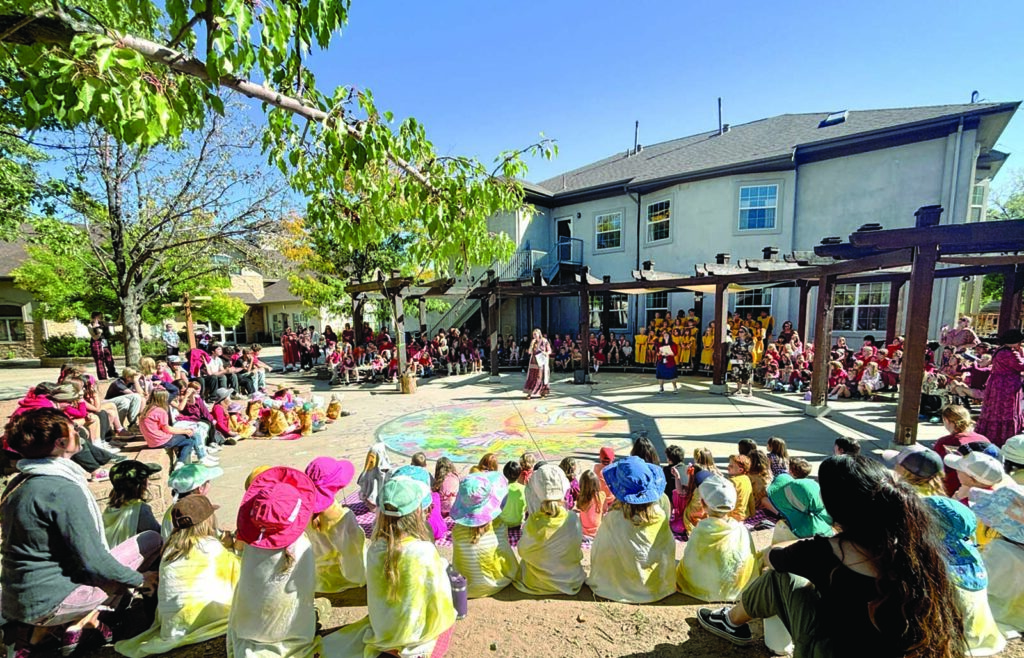
Mountain Phoenix Community School, located in Wheat Ridge, opened in 2007 as Colorado’s first public charter offering Waldorf education: a curriculum typically available only through private schools with high tuition costs. As a public charter school, Mountain Phoenix operates as a nonprofit with its own governing council, receives public funding like traditional public schools, and adheres to the same state standards and assessments. It’s one of 18 charter schools authorized by Jefferson County School District.
The school emphasizes play-based early childhood education, delaying formal academic instruction until first grade. Art, music, foreign language, and a textile arts class called “hand work” are taught alongside traditional subjects. “I think families and students who are tired of constant drilling and academic work appreciate the balance that we have with these disciplines,” says Maggie Payne, upper school director at Mountain Phoenix Community School.
For Payne, the question isn’t whether charter schools are superior to traditional schools; it’s about finding the right fit for each child. “It’s hard to support a kid to positive outcomes if your educational model just doesn’t work for them,” she says. “We’re spending a lot of time and money and effort when perhaps just a change of setting can make life better for a student.”
Payne emphasizes the importance of all public education options, stating that Mountain Phoenix serves as a choice within the public education system and not a replacement for it. “We don’t think that our educational approach is the be-all, end-all, for everyone,” she says. “I’m all in favor of traditional public schools. Public education is so, so important.”
For Wheat Ridge, the presence of schools like Mountain Phoenix and Compass Montessori alongside traditional public schools could be an asset. “I think Wheat Ridge, as a city, benefits from having options for its residents,” Payne says. “It could be a draw to families. It could be part of why they’re choosing to live in Wheat Ridge in the first place. Being able to meet the span of all learners’ needs and families, being able to have the option to choose what works for their children to be successful and learn along the way – that’s really important.”
The question is whether traditional public schools can continue to meet the diverse needs of students while trying to build back trust that was damaged during the Covid-19 pandemic. For local families, the answer will determine their children’s educational future.