


Wheat Ridge residents have seen inflation in the grocery aisle, on utility bills and in nearly everything they buy. But it is less obvious when inflation is parked inside a local fire station.
According to West Metro Fire Rescue, the cost of a fire engine has increased from $720,000 in 2018 to $1.3 million today. Cardiac monitors that cost $25,000 in 2018 now cost about $60,000. The last successful property tax increase benefiting the fire district was in 2006.
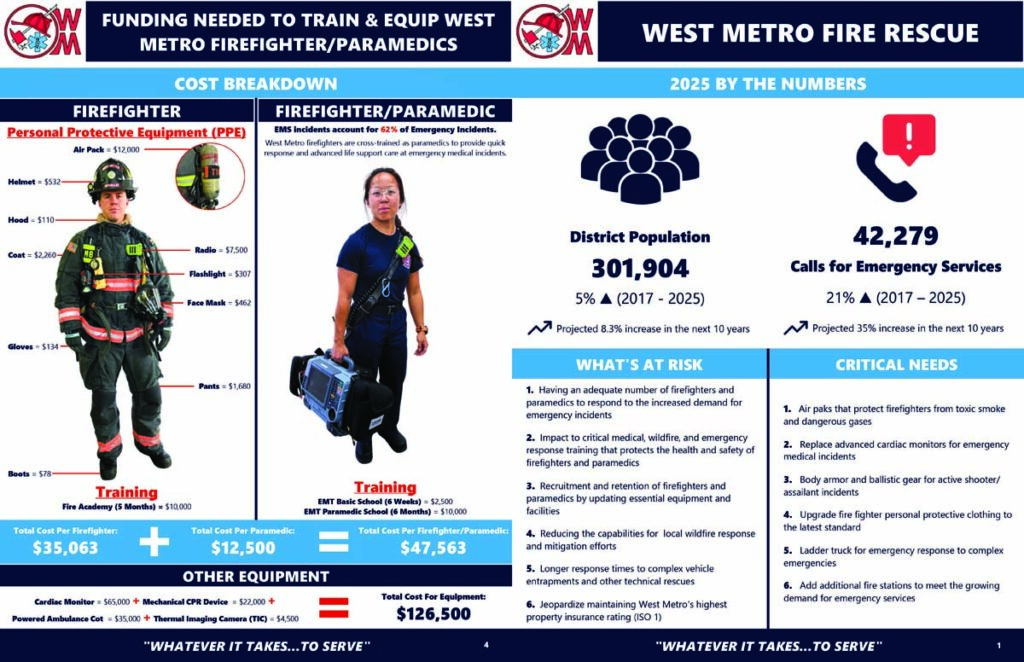
At the same time, the work has grown. West Metro received 42,279 calls for emergency service in 2025, or about one call every 12 minutes. Medical calls accounted for 26,372 calls, or 62% of the total, and resulted in 19,049 hospital transports.
The district serves 108 square miles across Jefferson and Douglas counties, including Wheat Ridge. Today, West Metro operates 17 fire stations with 425 cross-trained firefighter paramedics and 66 civilian support staff.
Wheat Ridge’s population grew 5% from 2017 to 2025 and is projected to grow 8.3% over the next decade. Calls for emergency service grew 21% during the same period and are projected to increase 35% in the next 10 years.
A major factor is aging in place, the trend of older adults remaining in their homes rather than moving into assisted living or nursing care. That means firefighters are increasingly responding not only to fires and cardiac arrests, but also to welfare checks, fall calls and medical issues behind ordinary front doors.
Fire districts are primarily funded through property taxes, calculated by applying a mill levy to assessed property value. But recent state property tax changes have constrained the revenue local fire districts rely on. In 2020, Colorado voters approved Amendment B, repealing the Gallagher Amendment. Later legislation lowered assessment rates or increased valuation discounts, while SB 24-194 opened the door for impact fees and sales tax options.
Those changes eased tax bills for property owners, but also narrowed the tax base that special districts depend on. Fire Chief Jeremy Metz called the result a “property tax conundrum.”
West Metro’s finances were self-sustaining through 2024, but that changed in 2025. The district projects a revenue shortfall of nearly $40 million in 2027.
The district says its infrastructure has not kept pace with demand. Metz said West Metro is “essentially built on a 1970s infrastructure right now.” The district says it needs to expand fire stations and personnel, with one future station planned near Fifth Avenue and Wadsworth Boulevard.
City Council members questioned whether West Metro could cut costs by using smaller vehicles or sending fewer responders to medical calls. Metz said the district has studied those options and that its model depends on cross-trained firefighter paramedics responding from both engines and ambulances. With 17 fire stations and 14 ambulances, there is not an ambulance at every station. In a fire, cardiac arrest or stroke, he said, “it’s minutes and seconds. We need to stop the clock.”
Captain Mike Mulcahy said the public often sees the fire truck, but not all of the calls it responds to.
“I never expected that we would become caretakers, counselors, plumbers and electricians, Christmas light decorators,” Mulcahy said.
A Community Advisory Group, or CAG, found the district is a high-performing and efficient organization operating with limited excess capacity, but expenses are increasing faster than revenues. The CAG concluded property tax is no longer advisable or sufficient as the sole funding source.
A March 2026 poll found 82% of respondents had confidence in how West Metro would spend funds. After education, 59% supported a 0.5% sales tax increase, with 43% a definite yes. The tax would cost 25 cents on a $50 purchase and raise about $27.8 million. By comparison, support for a 3-mill property tax stayed at 43%, with only 22% a definite yes.
The CAG recommended a sales tax ballot question in November 2026, private fundraising, a West Metro Fire Foundation, impact fees and a possible capital bond measure in the next two to four years.
If new funding does not materialize, Metz said the district will have to make cuts that affect staffing, training and equipment. “We will not be able to sustain the number of firefighters and paramedics,” he said. “That’s really what’s at risk here.”
According to Colorado Deputy Press Secretary Ally Sullivan, “The Governor has delivered major statewide property tax relief for homeowners and small businesses. He is committed to saving Coloradans money on property taxes, while ensuring funding for important services Coloradans and our communities rely on like fire districts. We remain open to helping fire districts to find the best past forward to support first responders and keep communities safe.”
For Wheat Ridge, the question is not whether fire protection costs more than it used to. The question is what kind of emergency response residents expect when the next call comes, and whether they are willing to pay for it before the clock starts.