

Causes come and go. No Nukes, Save the Baby Seals, UNICEF, Live Aid, protect the ozone, acid rain, DDT and the eagles, Save the Turtles. We’ve rallied around countless movements, each demanding attention and behavioral changes. But what happens when several important causes collide? When protecting our air, conserving water, and preserving our environment all demand action simultaneously?
Over the past several months, the Neighborhood Gazette has published a full-page air quality awareness campaign. For good reason. Scientific research links fine particulate matter (PM2.5) and ground-level ozone to respiratory and cardiovascular disease. Then come the wildfires.
Massive fires destroy neighborhoods and send smoke hundreds of miles. People shut down evaporative coolers, reconsider backyard barbecues, and limit campfires. The letters and phone calls start coming. It’s a big deal!
And then comes the water shortage. Suddenly, we’re discussing declining Colorado River flows, shrinking reservoirs, drought, and a century-old water allocation system developed under very different climatic conditions.
Watering restrictions tighten. Two days a week becomes zero. Denver encourages neighbors to report watering violations. Homeowners sneak outside to water at night. Wheat Ridge considers changing front-yard landscaping regulations.
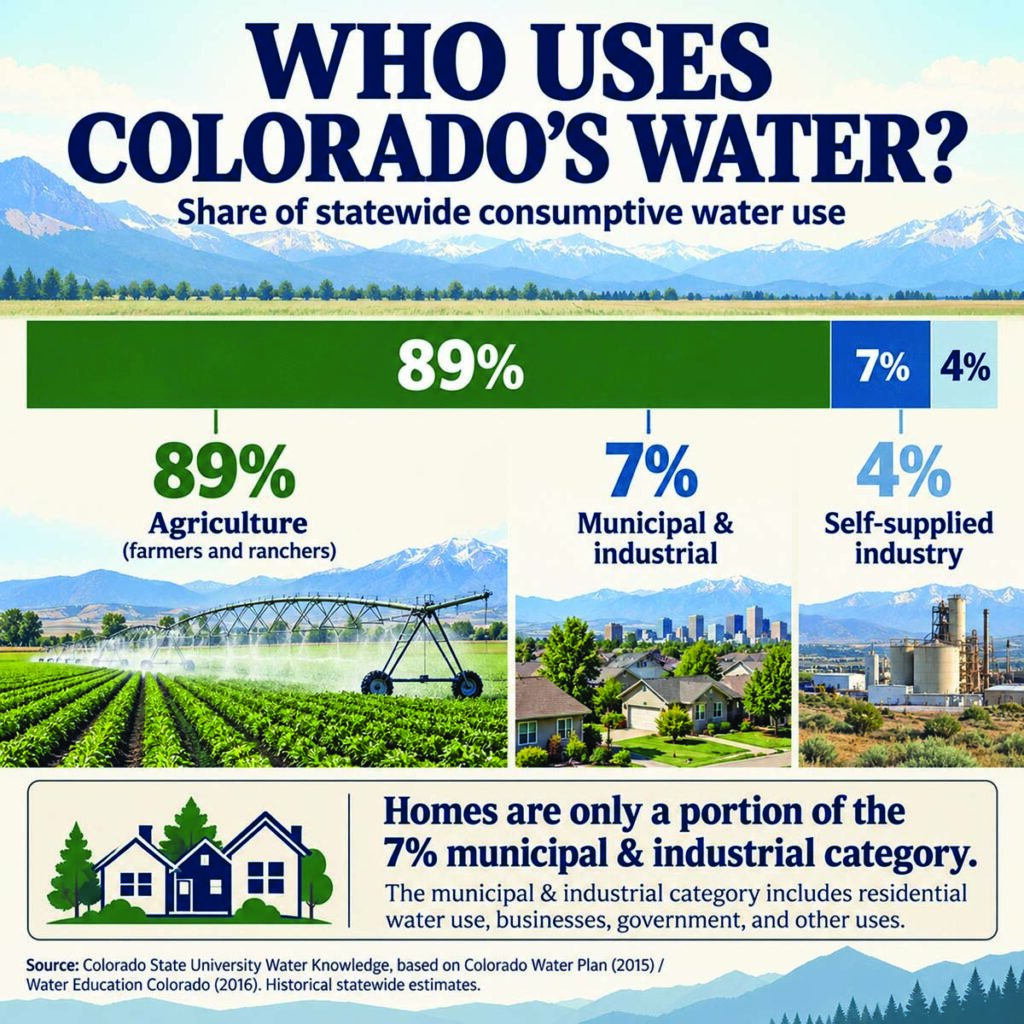
But here’s something missing from this conversation. Agriculture accounts for approximately 89% of Colorado’s consumptive water use. Yet public conservation messaging focuses heavily on residential lawns and sprinklers. Where is the equally visible conversation with farmers about modernizing irrigation systems, reducing water losses, and investing in efficient agricultural practices? Farmers are essential to our economy and food supply. They face financial and water-rights constraints. But meaningful conservation requires examining where water is consumed, not simply where restrictions are easiest to enforce.
This raises another question: How many environmental priorities can people realistically manage? Behavioral scientists study the finite pool of worry. When concern about one threat intensifies, attention to other threats can diminish.
I asked Kelsey Simpkins, Communications and Programs Manager at the Regional Air Quality Council, whether environmental issues compete for public attention.
Kelsey shared: “I do think the topics compete to some degree, especially when people are asked to not water their lawns, as well as do XYZ for air quality, for instance. And our surveys show that when there is no wildfire smoke, or air quality doesn’t make the news, they really don’t think about it much. So I do think whatever is the most timely, impactful issue at a time gets the attention — but if we have wildfire smoke and a watering restriction at the same time, those are the moments when I see people clearly caring about more than one thing, because they’re both such timely and impactful things on individuals.”
I also spoke with Jarod Roberts, Vice President of Water Resources at Consolidated, who raised another concern: trust. Jarod believes declining public confidence in government has weakened conservation messaging. When residents distrust the messenger, they question the seriousness of the problem.
Research in risk communication supports this concern. People cooperate when they trust the information and believe sacrifices are shared fairly.
Are we experiencing environmental fatigue? Conserve water. Reduce emissions. Protect trees. Change landscaping. Limit outdoor burning. Individually reasonable requests can collectively become overwhelming.
Yet these challenges are interconnected. Trees cool neighborhoods but require water. Rising temperatures worsen drought and ozone pollution. Drier landscapes increase wildfire risk.
Perhaps sustainability needs fewer competing campaigns and more coordinated solutions. Less finger-pointing. More science. Greater transparency. Conservation expectations that include everyone, from homeowners to agriculture. Because sustainability isn’t about choosing which environmental cause matters most this month. It’s about recognizing that they all matter, all the time.