

I was born in the 70’s in Denver, and anyone who grew up here then remembers the seasons as part of our identity. As kids, we always saw the first snow arrive right after the first days of school. It was dependable, almost ritualistic. And without fail, it would snow the week of Halloween. We didn’t question it; we simply knew that whatever costume we chose had to fit under our heavy coats. That was just the way it was in the 70s and 80s. Even at the tail end of summer, you could look west from the Denver metro area and see snow clinging to the Continental Divide. By September, it was snowing again. That was Colorado. That was normal.
Early this summer, I drove to Salida to spend a couple of days with a friend. I was taken aback for reasons that had nothing to do with beauty. In May, when I went to see my friend, the mountains were already barren. Not “light on snow.” Not “melting early”. Barren. Stripped. Empty. They looked as if someone had scraped away what was supposed to be there. It was unsettling in a way that sat heavy in my chest. Something wasn’t missing, it was gone. And that distinction matters. Missing implies it can be found. Gone means it simply isn’t anymore. And that’s what has happened in Colorado: the snow as we knew it, the abundance of water as we knew it, is gone.
My sister suggested that maybe the people ignoring watering restrictions aren’t natives, and maybe that’s why they aren’t taking the drought seriously. Maybe they don’t know that we used to see snow year-round. Maybe they don’t understand how dramatically things have changed. And in conceding that, I realized something important: what those who don’t know-don’t know-is that what we are seeing now is as real and as frightening as it can ever get. This isn’t a temporary inconvenience. This is a crisis unfolding in real time.
Consolidated Mutual Water Company VP Jarod Roberts reported that August water use dropped by 17%. But overall, Consolidated Mutual has only achieved a 5% reduction-far from the 25% needed to overcome drought conditions. That gap is not abstract. Those reserves must overcome it before they can replenish what’s already been depleted. And I found myself wondering: how many residents in the Denver metro area are native-born Coloradans? According to U.S. Census Bureau data from 2022–2024, roughly 60% of the larger Denver metro area-including Wheat Ridge and Jefferson County-are not native to Colorado.
So, I wonder if maybe, just maybe, the reason Consolidated Mutual Water issued over 1,200 first notices, with less than half resulting in any change in outdoor water use, and why second warnings saw compliance drop to a mere 28%, is because most residents don’t actually understand how dire the situation is. Those of us who grew up here remember what used to be normal. We remember what used to be expected. And we know how far from normal things have become.
Consolidated Mutual Water delivers water to more than 100,000 residents in our area. They have not yet levied fines or penalties against non-compliant consumers. But if behaviors don’t change, it’s likely they may have to consider this alternative. Trust us natives when we tell you: these Rocky Mountains are different now. The snowfall is different now. The water supply is different now. When we hope for a good snow, the snow doesn’t come. This is abnormal for Colorado historically, pre-1990s, but those days are gone too.
Anyone can look west and see there is no snow. And that is where our water originates. Let its absence ring alarm bells in our resident’s minds.
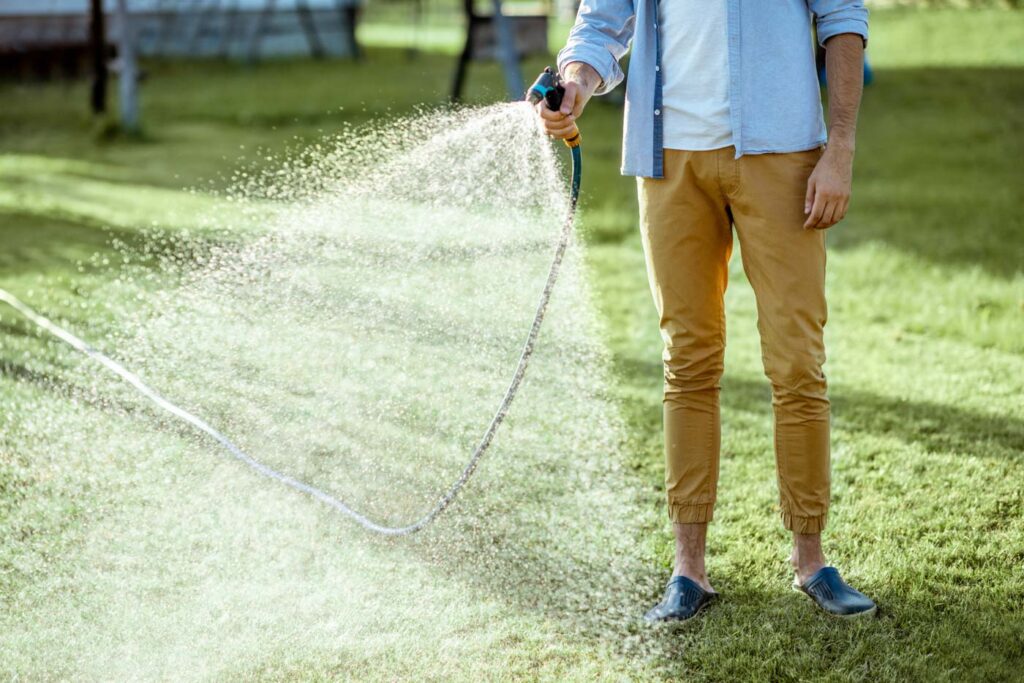
With this in mind, we at the Neighborhood Gazette want to keep this conversation going. As we enter fall, beginning October 1st, all lawn watering and spray irrigation are strictly prohibited. It is reasonable to give a little water to trees and shrubs to support their root systems, however, limit it to hand watering only or drip irrigation only and before 10 am or after 6 PM and ensure this precious resource is not pooling or running-off You can also use the eco-friendly, water-conserving method of creating a layer of soil insulation around your trees. Rake and pile fallen leaves at the base of the tree to form a natural mulch layer. This simple act can significantly strengthen a tree’s resilience through winter and drought while also reducing the use of plastic bags to discard leaves.
And remember: here in Colorado, lawn grasses are naturally going dormant. It cannot be summer every day, even in Colorado and even for our grass. It needs the opportunity to go dormant in alignment with the larger ecosystem as it enters its fall and winter states. There is no longer a need to water our lawns which are ready for their winter nap.
And in the meantime, let’s all hope for a snowy winter here in the metro area and especially in the high country of Colorado.