

This July, communities across the country are beginning to mark America’s 250th birthday, which will be officially celebrated in 2026. It is a natural moment to look back at where we’ve come from and to look ahead at what kind of community we want to be in the next generation. For our twelveblock Town of Mountain View, that big national milestone sits alongside our own story: from farm fields on the edge of Denver to a small but resilient town surrounded by a growing metro area.
Before there was a town
Long before there was a Town Hall at 44th and Benton, this area was open land on the western edge of Denver’s early development. In the late 1800s and early 1900s, land speculators and developers saw opportunity in the rolling ground between the city and the agricultural areas to the west. The area that would become Mountain View was laid out as part of a suburban addition, with a simple street grid, modest residential lots, and a commercial strip along what is now West 44th Avenue.
In those early years, people here lived closer to farming than to freeways. Dirt roads, small houses, and local shops supported residents who traveled by foot, horse, and eventually streetcar. The wider region was still defining itself—Colorado had only become a state in 1876, and the idea of a dense, connected metro area was still decades away.
Fiftyeight “yes” votes
By 1904, enough people were living in this little neighborhood that the question of local control came to the forefront. Residents wanted more say over basic services, land use, and how their streets and alleys were maintained. That summer, a petition circulated asking to incorporate as the Town of Mountain View.
On September 6, 1904, eligible voters gathered—local history records often cite a meeting in a small storefront along Sheridan—to decide whether this place would officially become its own town. When the ballots were counted, just fiftyeight people had voted “yes” and fortyeight had voted “no.” Ten votes made the difference between remaining an unincorporated edge of someone else’s jurisdiction and becoming a separate community with its own name, boundaries, and local decisions.
It’s easy to romanticize that moment, but it likely felt very practical to the people in the room. They were thinking about water, streets, safety, and how to manage growth coming from Denver. In its own way, that 1904 vote was this community’s first big “future vision” conversation.
Growing up in the shadow of the city
Over the decades that followed, Mountain View remained physically small even as the region around it changed dramatically. Cars replaced streetcars. Farmland and open space gave way to residential neighborhoods, commercial corridors, and, eventually, the regional roadway network we know today.
Mountain View sat in the middle of all that change, surrounded by larger neighbors but determined to keep its own identity. The town adapted to new building styles and new businesses along 44th, updated its ordinances, and responded to new expectations for public safety, code enforcement, and infrastructure. At the same time, it stayed what it had always been: a place where you can cross the town in a short walk and still run into people you know along the way.
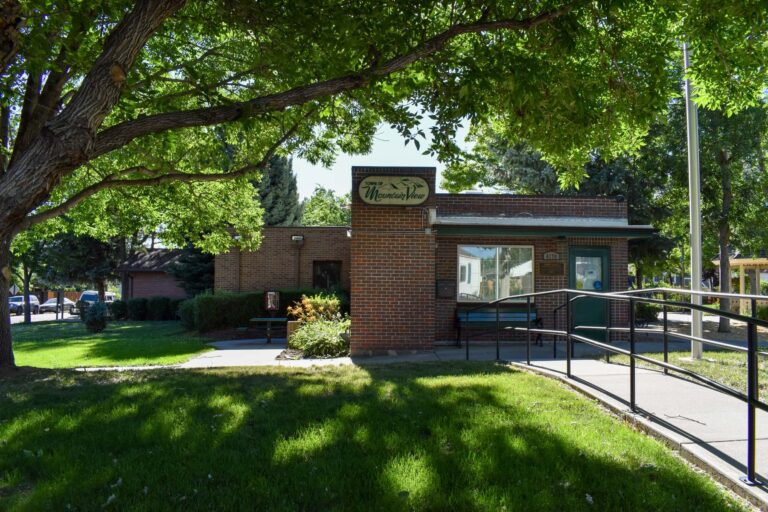
Today, our town boundaries are familiar to many of us almost by heart: Sheridan to Fenton, 41st to 44th. Within those twelve blocks are a park, Town Hall, small apartment buildings, singlefamily homes, alley garages, longtime local businesses, and new storefronts. We have residents who remember when the surroundings were much quieter—and residents who moved in last year because they liked the walkability and neighborhood character of a small town in the middle of the city.
America at 250: what comes next for Mountain View?
As the country approaches the 250th anniversary of the Declaration of Independence in 2026, national conversations are focusing on where we’ve fallen short of our ideals and what we can do better in the next 250 years. Mountain View can have its own version of that conversation at a neighborhood scale.
Some of the themes we hear from residents are remarkably consistent with what our founders worried about in 1904, just with twentyfirstcentury details:
• How do we maintain safe, wellcaredfor streets, alleys, and sidewalks in such a compact town?
• How do we support thriving small businesses on 44th Avenue while keeping the character of nearby homes and blocks?
• How do we protect and improve our limited green space so kids, older adults, and everyone in between have places to gather and play?
• How do we make it easier and safer to walk, roll, and ride in and through town, including for people with mobility challenges?
• How do we keep Mountain View a place where neighbors know and look out for each other, even as housing, demographics, and the broader region change?
The decisions we’ll make over the coming years—about land use, infrastructure investments, public safety, parking, sidewalk and alley priorities, storm drainage, and community programs—will shape how well we live up to those values. While national and state anniversaries will come and go, the local choices we make can have lasting, everyday impact on how it feels to live here.
Inviting your voice into the next chapter
In 1904, barely more than a hundred people cast votes that decided Mountain View’s future. Today, our population is larger, our issues are more complex, and the regional context is more demanding—but the basic idea is the same: this town is shaped by the people who show up, stay informed, and share their ideas.
As we head toward America’s 250th year, Mountain View has an opportunity to hold its own “future of our twelve blocks” conversation. Over the next year, you’ll see more information about upcoming meetings, public input opportunities, and policy discussions that will influence how Mountain View evolves. When you see those notices—in this gazette, on the town website, or posted at Town Hall—we encourage you to take a few minutes to read, ask questions, and, when you can, add your perspective.
Those neighbors in 1904 probably didn’t imagine what Mountain View would look like in 2026. We have the advantage of seeing more than a century of change behind us as we think about what we want the town to be in 2050 or 2100. This America 250 moment is a good reminder that even in a twelveblock town, the future is not something that just happens to us—it’s something we build together, one decision and one conversation at a time.