

Happy November, my nature-loving friends. Ken Hall, aka Bird Nut, here.
Migrating birds have migrated. Local, year-round birds are busy stashing winter supplies of fruit and nuts. Foliage has transitioned into a dull gray. Sounds a bit depressing, but in reality, it just opens up new opportunities for bird and nature nuts. Not only are there better viewing opportunities because of the now-bare limbs, but cooler temperatures also make it more comfortable to view the birds that call Colorado home over the winter.
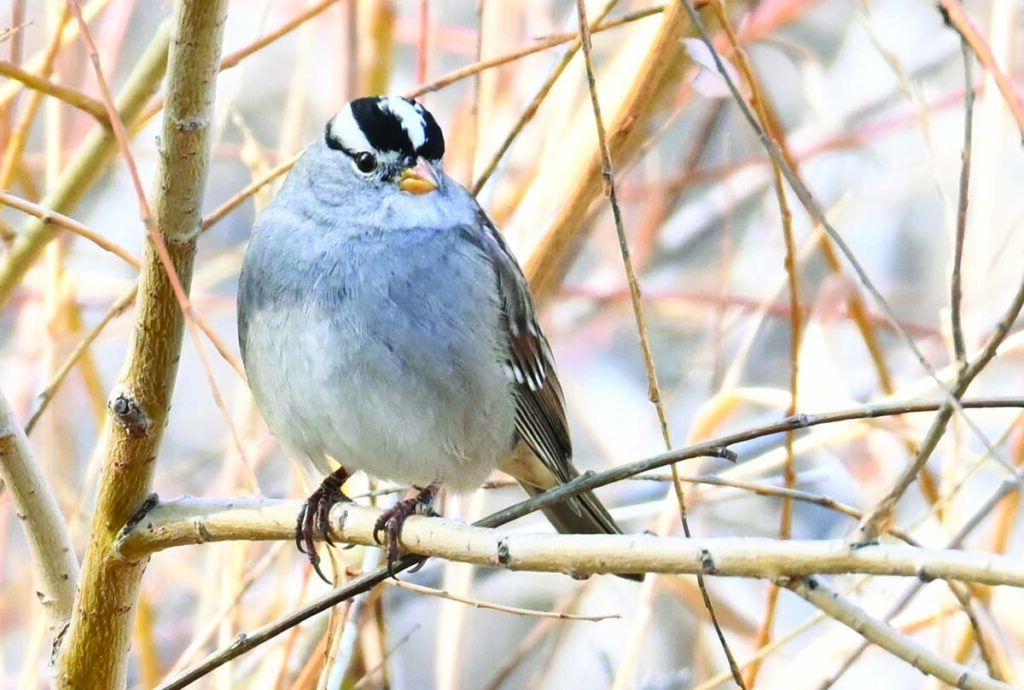
Most of the remaining birds are year-round residents, but I want to introduce two that ride in with the cold and leave with the first tree buds of spring: the Dark-eyed Junco and the White-crowned Sparrow.
Both birds are at the top of the cuteness scale. Both belong to the very broad sparrow family, and both are among the most commonly seen birds at our feeders and along the many greenbelt footpaths over the next four to five months. So, it’s nearly a shoo-in that you’ll see one.
First, I’ll introduce the Dark-eyed Junco, a hyper little ground feeder that seems always to be on the move. There are subgroups, all of which we’ll see over the next few months: the Oregon, Pink-sided, White-winged, Slate-colored, Gray-headed and Red-backed juncos.
In North America, their population is estimated at more than 260 million, second only to the American Robin. It can be a great challenge to locate as many of these varieties as possible on a short wander or at your backyard feeder.
The Gray-headed is our only year-round junco. These birds nest on or close to the ground above 8,000 feet, resulting in high nest loss due to predation. To counter this, they will most often have two nests per year, hatching three to five young. Amazingly, these little ones will leave the nest in nine to 12 days.
They return to the same wintering area each year, usually spending the entire winter in a 10-acre area. The odds are good that some of the birds at your backyard feeder visited last year.
Rarely will you see these little ones more than 15 feet off the ground, but they gather to rest side by side higher up in evergreens at night. Commonly referred to as snowbirds, they seem to drift in with the first snowflakes. The other varieties arrive from much farther north shortly after the Gray-headed Juncos, migrating predominantly at night and flying low to the ground.
Although there are very definite differences among the six varieties, they have some commonalities. Most notable is their white, flared tail when alarmed during a short, fluttering flight or when simply moving from point A to point B. They winter in mixed groups of five to 30 birds.
There is so much more to the Dark-eyed Juncos, but I’m allowed only so much space and want to introduce you to another beautiful little winter friend: the White-crowned Sparrow.
One of the few aptly named birds out there, they arrive about the same time as the juncos. They also nest at high elevations in Colorado. At 9,000 to 11,000 feet, you can see these cute little sparrows in the summer. But for us flatlanders, we have to wait until fall, when cooler temperatures bring them down.
They are some of nature’s most perfectly painted little birds. Even with my limited hearing, I can appreciate their beautiful song.
Much like the juncos, they are mostly ground feeders. They eat insects, but in winter, mostly seeds. Watching them feed reminds me of the bunny-hop dance I was taught many years ago: two hops forward, two scratches back. They are uncovering overwintering insects or seeds buried in leaf litter. Their feeding style reminds me very much of that of Spotted Towhees.
Many White-crowned Sparrows migrate from as far north as Canada, typically returning to the same area each winter. These birds learn and use distinct song dialects from their local territory, then communicate those dialects to birds from other territories. So, in effect, they are bilingual.
A great place to see White-crowned Sparrows is in the rabbitbrush near the Youngfield parking lot. They can be tough to photograph because they never hold still, but that makes it fun.
Hopefully, this writing brings a bit of interest in these very common and unique little fall and winter birds. I look forward to meeting you on the trail. Have a wonderful and blessed Thanksgiving. God bless.
Follow my photos, or just message me on Facebook at Bird Friends of Colorado and Birds of Colorado.