

Construction and demolition materials are a significant source of waste in the United States. When buildings are torn down, the process typically generates about 90% of the overall generation of waste in the construction cycle, meaning that old buildings usually end up in the landfill.
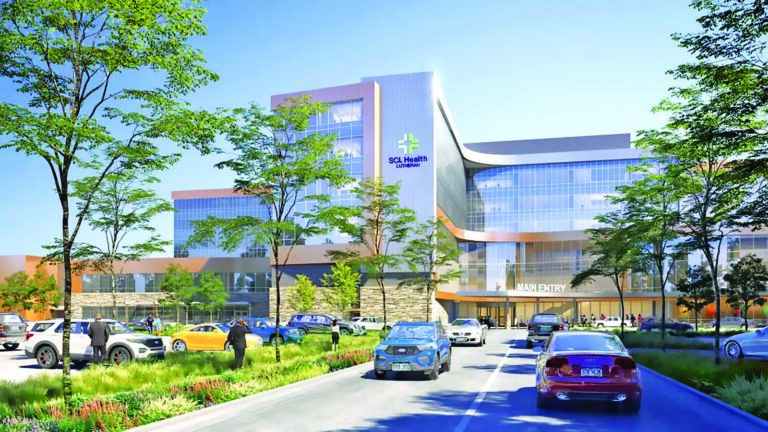
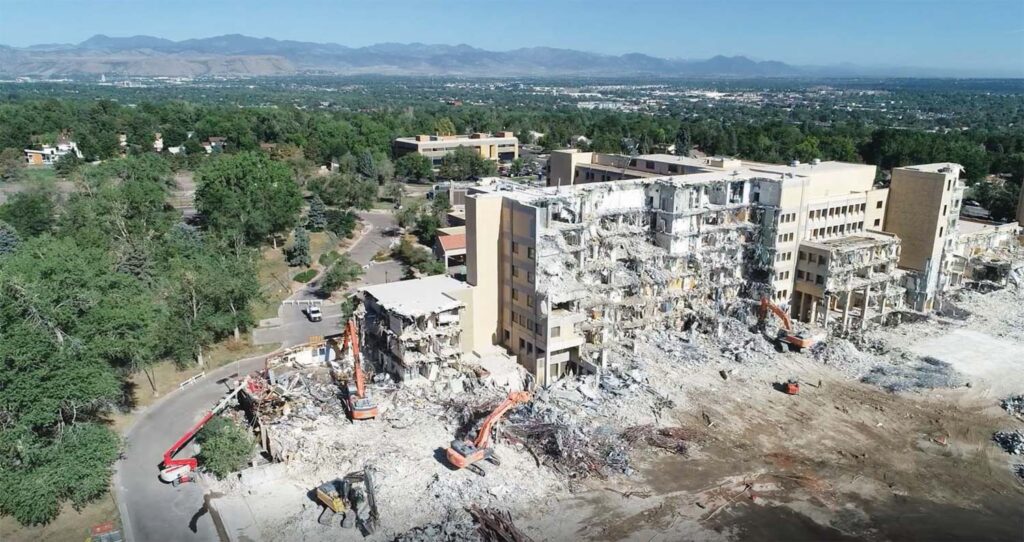
Some Wheat Ridge residents may have noticed that there is a big demolition project underway at the former Lutheran Hospital campus, where Colorado-based developer E5x has started redeveloping 100 acres between W 32nd and W 38th Avenues into a multi-use community called Legacy. But, this is not a typical demolition project – E5x has opted to deconstruct the hospital buildings, dismantling them in pieces to recover the reusable components.
Copper, concrete, asphalt, metals, and brick are the main materials that can and will be recycled, with some electrical and mechanical equipment, generators, chillers, and switchgear also finding a new life. E5x has also focused on reusing some materials on-site, like concrete that will be crushed and used as a road base.
Chris Elliott, president of E5x, said “the biggest challenge we have faced is understanding just what we would encounter as the hospital is demolished,” adding that the structures were built over a 100-year period and presented a myriad of construction techniques as a result. To properly assess the potential for salvaging recycled materials from each building, E5x took apart the campus piece-by-piece, Elliott said. “We can maximize the reuse of materials if we can sort them and make them ready for their next application.”
The Sustainability Action Plan (SAP) dedicates an entire section to solid waste and recycling. The main goals are to reduce negative impacts of waste management on city infrastructure and the local environment and to improve waste management behavior by residents, businesses, and institutions. Since the Legacy development is so substantial, the way E5x and the other developers who will eventually work on the property deal with waste will have a considerable impact on Wheat Ridge.
According to the Environmental Protection Agency, the largest building sector that generates construction and demolition waste is nonresidential demolition, which describes the Lutheran Hospital. But so far, E5x has recycled or reused 30,000 tons of construction and demolition materials, 74,000 tons of concrete and asphalt, and 10,000 tons of steel and non-ferrous (aluminum) metal. That accounts for a 74% diversion rate of materials from landfills. E5x estimates that demolition and deconstruction will be complete in early 2027. As the SAP explains, landfills are detrimental to the environment and to the neighborhoods surrounding these facilities, impacting the air and water quality and community health outcomes. Diverting almost three-quarters of the waste from landfills is a meaningful effort.
If the deconstruction of Lutheran is any sign of what will come, there is hope that Legacy will set an example that guides similar sustainable actions for future development in the city.