


After nearly four years of construction, two new continuous flow intersections (CFIs) opened on Wadsworth Boulevard in December, marking a major step in one of the largest infrastructure projects in Wheat Ridge history.
The CFI at Wadsworth and 38th Avenue opened on December 9, followed by the second intersection at 44th Avenue on December 16. These intersections are designed to reduce traffic congestion and accidents along a stretch of road that 45,000 commuters use daily and previously had a crash rate over four times the state average.
Early results have been positive, according to Wheat Ridge Police Chief Christopher Murtha, who spoke with the Gazette on December 15. “It seems that people have been navigating it well,” he says. “We haven’t had any collisions that were reported or any significant collisions (at the 38th Avenue) intersection since the opening.”
The $60 million Wadsworth infrastructure project, which started in November 2021, includes improvements to the 1.5-mile stretch from 35th Avenue to I-70 with three lanes in both directions, three miles of new sidewalks and trails, and completely rebuilt underground utilities including water, sewage, drainage and telecommunications lines.
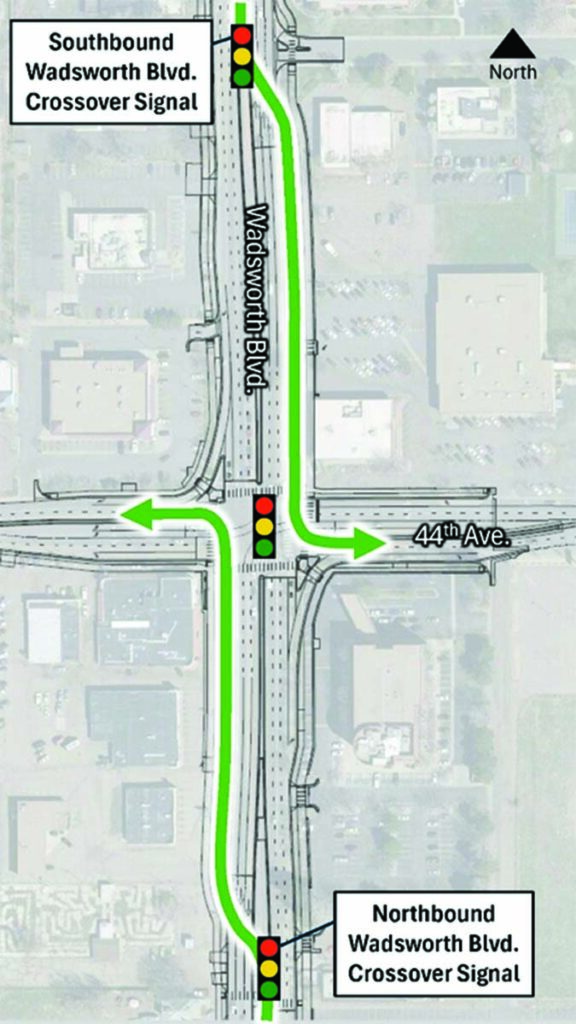
CFIs, like roundabouts, differ from traditional intersection design. Instead of waiting in the middle of an intersection to turn left, drivers cross over to the opposite side of the road before reaching the main intersection, guided by traffic signals roughly two blocks in advance. The design is meant to remove the left-turn signal step at the main intersection.
“Compared to other intersection types, the CFI design best reduces wait times, makes traffic flow smoother, and improves safety by reducing conflict points where crashes typically occur,” says Amanda Harrison, the City of Wheat Ridge’s communications manager. “CFIs also require less land for construction and shorten crossing distances for pedestrians and cyclists compared to traditional intersection designs.”
Colorado has seen an increase in CFI use in recent years, with Douglas County opening three partial CFIs on US Highway 85 in 2024, and Arapahoe County opening a CFI at Quincy Avenue and Gun Club Road in 2021. Durango and Loveland have used CFIs for over a decade.
The Wadsworth CFIs’ opening week was focused on acclimating the public. The Wheat Ridge Police Department sent a traffic unit to monitor the intersections on opening day and the day after, focusing on education over enforcement. “Our officers contacted a handful of people who made illegal turns and educated them and sent them on their way,” Murtha says. “We didn’t issue any citations to those people, given this is a shock to the system for people who have been driving that corridor for a long time.”
Officers observed some predictable confusion. “What we see is a lot of people getting to that decision point at the traffic lights and freezing up,” Murtha says. “It’s like they’re saying, ‘Do I go left? It feels like I’m going into oncoming traffic, or do I stay straight?’”
Some drivers attempted illegal left turns instead of proceeding past their intended exit and using the CFI as designed. “There are some folks who are certainly unfamiliar or uneasy with going past the exit and circling back around to it, and they try and make it work, despite the fact that it’s an illegal and somewhat dangerous turn there,” Murtha explains.
To help drivers adjust, officers repeatedly drove through the CFIs themselves to demonstrate proper use. The police department also posted educational messages on social media, sharing information about how to navigate the new intersections. One other challenge is that right turns on red from 38th and 44th avenues onto Wadsworth are now illegal, but some drivers are still making them despite the new signage.
The Wheat Ridge Police Department’s December 16 Facebook post about the 44th Avenue opening drew dozens of comments expressing divided opinions. Some residents expressed concerns about the CFI learning curve. “If it isn’t immediately obvious for the average human then it’s terrible civil engineering,” wrote Randy Ivie. Lisa Sanders wrote, “It’s a contemporary design in a neighborhood full of us older folks. We’re gonna get it wrong.”
Some expressed discomfort with the new setup: “Turning while looking at traffic coming head on is terrifying,” commented Linda Pacheco.
But CFI supporters pushed back. “It’s really not that hard to learn something new. The first few weeks will test our patience, but everyone will adjust,” Linda Spray said. Denise Fischer wrote: “I’ve been through the area many times, no issues! Turns work great, just pay attention and read. Stop the constant negativity, it’s exhausting!” Robert Uli agreed: “It’s not even a big deal. Went on this twice, pretty basic stuff, it’s actually pretty efficient.”
Several commenters drew on experience with similar intersections elsewhere. “They did a continuous flow on Santa Fe. Now that I’m used to it, I really like it and traffic does flow better.” Cathy Bowick Beekman said.
The city has extensive feedback, both positive and negative, about the new intersections. For those nervous about their first attempt, Harrison offers this advice: “Take a breath and follow the signs. The most important thing to know is that you don’t need to memorize anything in advance. The intersection guides you through it,” she says.
Chief Murtha, drawing on his previous experience managing traffic at FedEx Field stadium in Maryland, expects the learning curve to smooth out within a month, with knowledge spreading as more drivers get comfortable with the design. “People just need to see other people doing it,” Murtha says. “They need to see other people confidently moving through those CFIs and making that turn and getting into the appropriate lane at the light.”
Construction activity will continue along other parts of Wadsworth, with barrels and lane closures potentially adding to the complexity for drivers. “Our officers are seeing people that are confused about that and unsure about what’s going on, but I think once all that’s removed, it’ll be an even smoother transition,” Murtha says. The City of Wheat Ridge will continue to adjust signal timing and signage based on traffic patterns, which is standard for the construction of major intersections.
This infrastructure project is one of the largest in Wheat Ridge’s history, with 30,000 tons of recycled asphalt being used as the new road base. “The city understands the frustration that comes with long-term construction,” Harrison says, “but the CFIs are a key piece of creating a safer, more reliable, and more future-ready Wadsworth corridor.”
The project is on schedule to be largely complete by the new year, with finishing work scheduled for spring 2026. Several commissioned art pieces will be installed along the corridor, including public art on the sound wall between 35th and 36th avenues.
“We appreciate the community’s patience, and we’re committed to continuing to listen, adjust, and communicate as drivers get comfortable with the new intersections,” Harrison says.
As more vehicles travel through the CFIs each day, Wheat Ridge drivers continue to adjust to the new system. For a corridor that once had four times the statewide average crash rate, the promise of safer and more efficient travel may be worth the learning curve.