


Brian’s love of film photography started young with a gift from his dad.
The film camera from the ’50s had no light meter. Brian couldn’t see what he was focusing his camera on. He guessed the distance using a little dial on the lens, which showed how many feet away the subject was. The photos came out looking like they were straight out of the ’60s or ’70s.
By high school, Brian received another film camera from his dad. This one was from the ’60s. It was one of his favorite cameras he has ever owned. Today, he still shoots film photography. He appreciates that it forces him to think about every shot. There are only so many chances on a roll—the possibilities can fit in the palm of his hand.
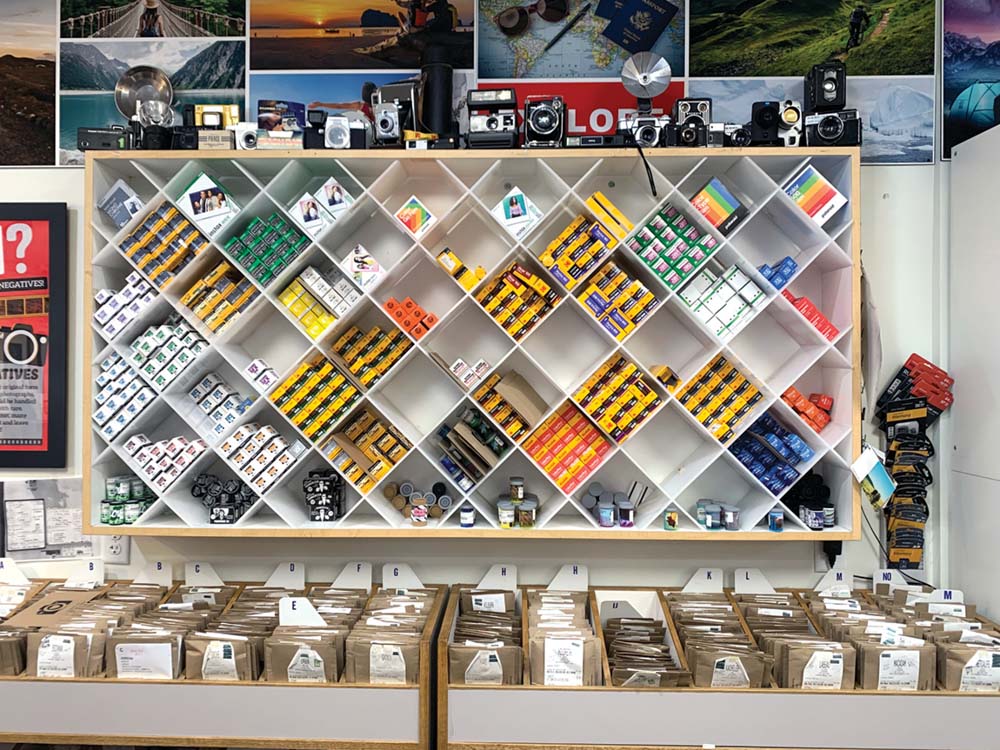
Brian balances life as a film photography artist with his work at Mike’s Camera, which sells cameras, photographic equipment and prints photos. For six years, Brian worked in the reproduction and restoration of photographs. For the past two years, he has worked selling cameras.
He enjoys forming relationships with customers. Many know him as a film photography lover. He especially loves when customers bring in old photographs. Customers, like an award-winning Army photographer who served in Vietnam, bring in historic photos.
“Show me a picture from 1935 of anything, and I’ll enjoy it,” Brian said.
Brian remembers when the film photography industry died off for a while. Even Brian quit shooting film for a stretch. Looking back, he thinks his hiatus may have been due to a lack of money. A saying in the film world is, “shoot film, stay broke,” he said. Rolls of film generally sell for $10. It costs about $20 to get them processed.
But now film photography is popular once again. Some movies are still shot on film, and some wedding photographers shoot weddings exclusively on film. Film photography makes up at least half of the business at Mike’s Camera. In a world filled with instant gratification, film photography involves a healthy dose of anticipation.
“You don’t know what you got until it’s processed,” Brian said. “You can’t just take a hundred and look through them all.”
Many modern digital camera options replicate the look of film-quality photos. Most Fuji cameras have ten or more film simulations. Camera companies offer new releases of their film cameras.
Film dropped off at Mike’s Camera is sent to their Boulder black-and-white darkroom, where it’s developed by hand. Film can also be developed at home in a little dark bag or even a can of coffee. Photos can be manipulated through burning and dodging techniques, or what Brian likes to call “ancient Photoshop.”
Brian watches as customers drop off a roll of film and can hardly wait a week until it’s processed. When they receive their prints, they are either excited, disappointed or have big questions. Customers sometimes ask why a photo came out a certain way.
“A lot of the time there’s no good answer to that question,” Brian said. “Sometimes they didn’t actually load the film.”
For Brian, both the beauty and the downfall of film photography are the trial and error of the process—and traveling through TSA X-ray machines. Once you use your roll of film, you can’t go back in time to recreate those moments. But he believes shooting film produces better photographers.
With film photography, there are three main decisions to make when taking a photo: shutter speed, aperture and how much light is coming in. Film speed and composition are also important. But even errors can produce a good photo.
“You may discover something on accident,” Brian said. “That stays with you. That benefits your experience and results.”
Brian once used a flash during the day while photographing flowers and ended up enjoying the results. They looked like different flowers with the flash.
“There’s really no limitation on what could turn out to be a good photo,” Brian said.
Like any artist, Brian has experienced lulls in inspiration and faces the balancing act of working in the same field as his artistic medium.
He enjoys taking film photographs of landscapes that catch his eye. He snaps empty street scenes, which require stretches of hanging out on sidewalks until the street is empty. Recently, he captured the textured, golden layers of a ceiling in an old building in Idaho Springs.