


This summer, Benny Paiz saw fish salvages at reservoirs across the state. He observed Green Mountain Reservoir looking more like a stream than a body of water. He noticed when they drained Lake Ontario. He also experienced the worst drought of his 26-year career.
The Wheat Ridge Parks, Forestry and Open Space Manager has been in the role for three years. Paiz previously worked for the city of Thornton as the open space and forestry supervisor. This summer felt like a balancing act, he said.
Paiz and his team navigated water restrictions from three water districts and used discretion on the lawn care they provided to the various parks in the city.
Wheat Ridge presents a unique challenge in that it doesn’t have its own water department. The city works with Wheat Ridge Water, Valley Water and Consolidated Water districts to bring water across the municipality. The water bill is taken care of at City Hall.
Areas within Wheat Ridge Water territory had stricter regulations. Wheat Ridge Water followed the city of Denver’s lead. It dropped water usage 20 percent below the average water usage amount and customers could only water two days a week.
For homeowners, watering twice a week can keep a lawn or garden alive. For large parks like Panorama Park, two days isn’t long enough to water the park. Paiz decided to pull a permit for parks that couldn’t follow the two-day water guidelines and received an exemption for larger parks like Panorama and Creekside.
“We had to balance the fine line of losing turf or going over on the water budget on some of the parks,” Paiz said. “Turf is an expensive asset for the city.”
Paiz was surprised that amenities like the splash pad at Discovery Park were able to stay open. It was turned off two days a week, a departure from its typical seven-day-a-week schedule.
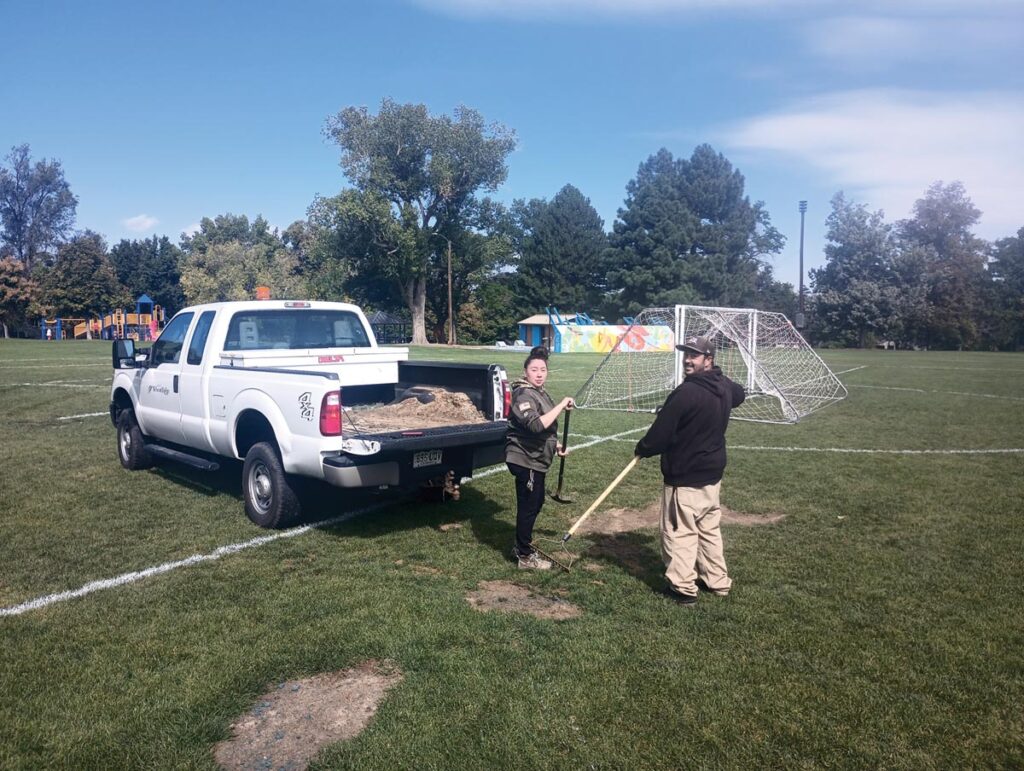
Paiz analyzed the uses for the various parks. For parks where kids play on the sports turf fields like Anderson, Prospect and Panorama, Paiz gave special consideration. If they lost too much turf on Panorama, it would make it hard and unsafe for the kids. With less grass coverage comes the possibility of thistle and other weeds popping up. The team also used more weed agents this year.
“The challenging part this year is trying to find that happy medium of saving water and keeping it safe and making sure that next year we’re gonna be okay with this grass going over the winter.”
Soccer field grass is usually cut at two and a half inches. This year, the city kept it at three and a half inches to try to maintain moisture in the grass.
The west side of the city uses non-potable ditch water from Lee and Baugh Ditches.
City Hall can be watered with ditch water and without restrictions, but Paiz decided not to use ditch water for that lawn, as citizens would be more likely to call with pushback because their yards are looking brown. Discovery Park is also watered with ditch water.
“We had some nasty calls about Discovery Park,” Paiz said. “It was very green this year, but it was non-potable water. If we didn’t use it, it would just go down the line and hit the South Platte River and just keep going all the way to Nebraska.”
Most golf courses also use non-potable water.
The new The Green at 38th park uses district water, but Paiz maintained it like normal.
“We spent over six million on the park,” Paiz said. “We’re not gonna lose that asset. That was probably one of our most heavily programmed facilities, so we kept it. That one we knew we just maintained like normal.”
Some of the pocket parks received less water. Some parks have older irrigation systems that are less efficient. Head-to-head watering systems are found in the newer parks, which allows for the irrigation system to spread an even layer of water throughout the entire park.
“Some of our smaller parks like Boyd really took a hit,” Paiz said.
Watering strategies were determined by how used the parks were. The data on this was obtained through a “boots on the ground” effort, Paiz said.
“My supervisors were out inspecting and trying to see where the kids were really,” Paiz said.
Discovery and The Green at 38th park were the most frequented city parks this summer.
Paiz oversaw a team of newer staff this summer, many of whom hadn’t been through a drought before in their careers. He spent a lot of his time doing visual inspections.
After years of experience, Paiz knows well when to give more water or to back off on watering a lawn.
“If the grass starts turning gray, you know it’s about to turn brown,” Paiz said. “You’re trying to keep it on that verge, but still safe for the kids.”
Staff in the department took the situation seriously, although it was tough on everyone. Even something as small as a tilted sprinkler head causing some dark spots in the grass raised concerns.
“They were going through and making sure every head was straight, trying to make sure that we’re not wasting water,” Paiz said.
Some staff members who had been here for 20 years and were used to making the parks look nice were tempted to bump the watering up, but Paiz had to remind them to bump it back down.
“It’s hard for someone who cares about their job to go by a park and it looks like crap,” Paiz said. “My previous experience helped me a lot with this one. I had been through a couple droughts.”
Paiz reached out to other municipalities like Northglenn and Commerce City to ask about their drought plans.
“The networking really helps,” Paiz said. “I don’t feel like I’m stuck on my own little island.”
Paiz finds one bright side of the situation: The entire state is dealing with the drought together, so many Wheat Ridge residents weren’t surprised the city had to make accommodations.
“We’re hoping for a good winter,” Paiz said. “I think even with a good winter, I don’t think it’ll pull us out. I think it’s gonna take a couple good winters to pull us out of this drought.”