

Happy February my nature loving friends. Ken Hall here, aka Bird Nut.
Being asked to help out my friends at the Neighborhood Gazette by sharing short articles about my passion for nature can be tough when it comes to finding subject matter for one of my least favorite months of the year. I usually continue my nature walks until something inspiring piques my curiosity. I have always had an overload of curiosity. I look at that as a blessing—my parents likely not so much during my younger, more curious years.
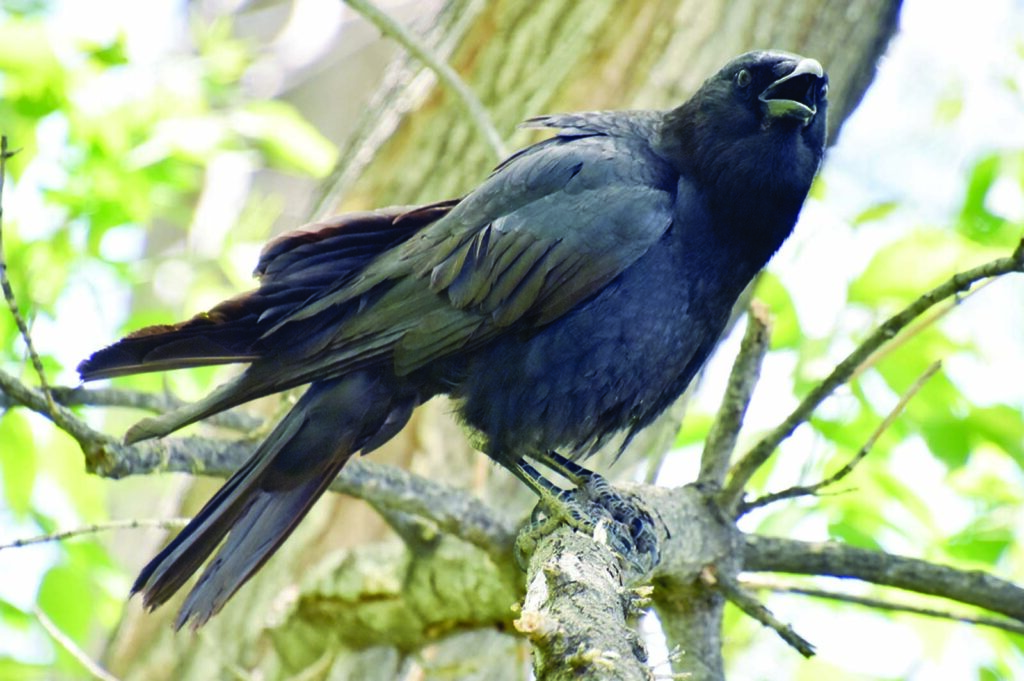
After a month of wanderings, I found inspiration in a rather unlikely place. Leaving the grocery store the other day, I was drawn to a cacophony (that means noise) all around me. Ring-billed gulls and crows must have been celebrating someone’s out-the-window litter treats. I sat for a while watching, predominantly the crows—dipping and diving, celebrating with many versions of a familiar song: “caw, caw, caw.” At that moment, inspiration hit me right between the eyes as I realized how little I knew about these familiar birds. Curiosity kicked in, and I was amazed at what I found.
Crows are far more than lead characters in early horror movies, although they can seem rather ominous in their black outfits as they sit and watch the world around them. They have earned places in idioms passed down through generations. “Eat crow” is believed to date back to the 1850s, when a farmer made a bet that he could eat anything and was presented with a crow for dinner. It didn’t go so well. Thus, when the mouth exceeds accuracy, you “eat crow.” “As the crow flies” is fairly self-explanatory—watch crows in flight, and they nearly always take the straightest route from point A to point B. Another familiar phrase is “crow’s feet,” which describes the lines around the eyes as we age. An optimist like me calls them smile lines; pessimists may be shopping for face-lifts.
Now for some fun and fascinating facts. Crows and their close cousins, ravens, are considered the smartest birds in North America—and that isn’t just an off-the-cuff statement. Extensive scientific research backs it up. Crows have large brains, with a brain-to-body ratio even greater than humans’. They have regional dialects, much like people, and they mate for life. Crows can even make tools. They have been studied shaping sticks into hooks to probe for food and solving complex puzzles.
When a crow finds a hard-shelled nut it can’t crack, it will often wait at a busy intersection for a red light, drop the nut for passing cars to crush, then wait for the next red light to retrieve its prize. Crows will hide food, but if they suspect they are being watched, they may fake the deposit and move elsewhere, concealing the treat in their feathers. They form close family units that can span up to five generations. Recently fledged crows often gather in their own groups, harassing anything—or anyone—that wanders by, a kind of avian trash-talking. As they mature, they stay within the family unit, helping feed and raise younger birds and even bringing food to adults on the nest.
Of all these traits, one of the most fascinating is that crow communities can hold grudges. Researchers at the University of Washington conducted an experiment in which they captured and banded seven crows while wearing caveman masks, then released them back on campus. When the researchers later walked across campus wearing the same masks, the crows scolded and dive-bombed them. Ten years later, more than half the crows across the entire campus still raised the alarm at the sight of those masks. But crows also remember kindness. If you were to drop a French fry each day while passing a group of crows, they would recognize you as the gift giver and respond to you for years.
There is so much more to these beautiful and fascinating birds, but space is limited. The next time you’re at the park, a fast-food parking lot, or even the grocery store, take a few minutes to really look at these birds. I’m sure they’re looking at you.
You can find me on Facebook at Birds of Colorado or Bird Friends of Colorado.
Hope to meet you on the trail.