


Much has been written about the Blue House: how some Lutherans purchased it to establish a tuberculosis sanitorium, and its ensuing history of caring for a burgeoning population of afflicted individuals who, eventually, were housed in specialized TB tents just west of the stately house.
Less known are the years the house served as a nurses’ dormitory with space for families visiting patients after the first hospital was built in 1921. Many residents have fond memories of the Tea Room & Consignment Shoppe ruBy the Lutheran Auxiliary. Nowadays, residents check on the structure frequently as they travel along 38th Avenue.
Yet, almost nothing is known about how the Blue House came to be. It sat on what was originally Henry Lee’s land, but he didn’t build it. Who, then, built the beautiful 16-room stately home that became known as the Blue House?
The person responsible for the planning, design and construction of this much-loved local icon was German immigrant William Dusedan, a civil engineer who built tramway lines used in mines. He didn’t stay long in America and called Colorado home for only a few years. But the stunning mansion he left behind has long been a source of pride to Wheat Ridge residents; its allure has lasted for 124 years. Happily, it’s just about set to continue for another century or so.
The 1900 U.S. Census shows the Dusedan family living in Brooklyn, NY, but the Silverton (CO) Standard newspaper reported William building a tramway for a mine there in 1898. Dusedan ran an ad a 1901 Rocky Mountain News seeking an architect’s drawing board for his office in Denver’s Mining Exchange Building, possibly to produce drawings for a local home.
Dusedan purchased an unimproved ten acres from Lee in 1902 for $5350. Tax records show a significant jump in property value from 1902 to 1903, indicating the land had been improved with structures. Dusedan, his wife Hulda and son only lived in the mansion 1902-05, but they made many improvements. They planted an orchard, dug an artesian well and bought livestock. In 1904 Dusedan advertised for a German-speaking farm hand, then, later, advertised to rent out the property.
Eventually, he sold the property for $12,700 to a group of German Lutherans, who were looking to start a health farm for people afflicted with tuberculosis. The years that followed guaranteed the mansion’s place in history.
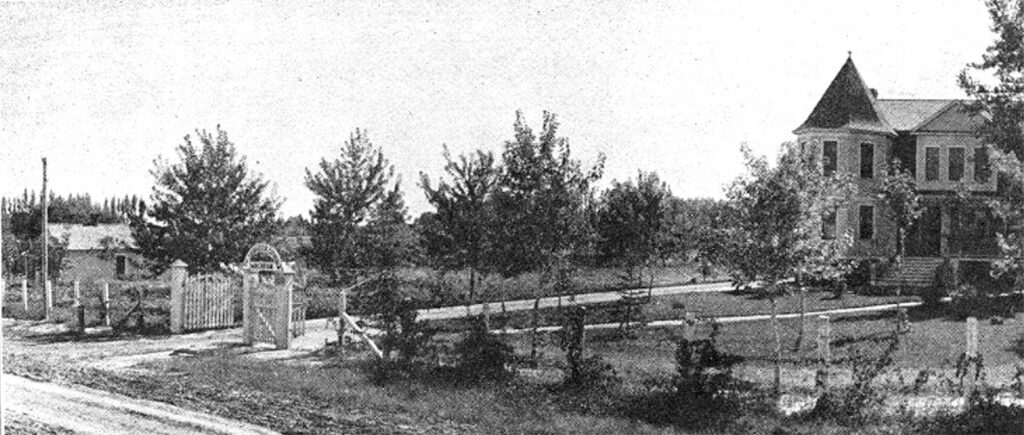
COURTESY OF WHEAT RIDGE HISTORICAL SOCIETY