


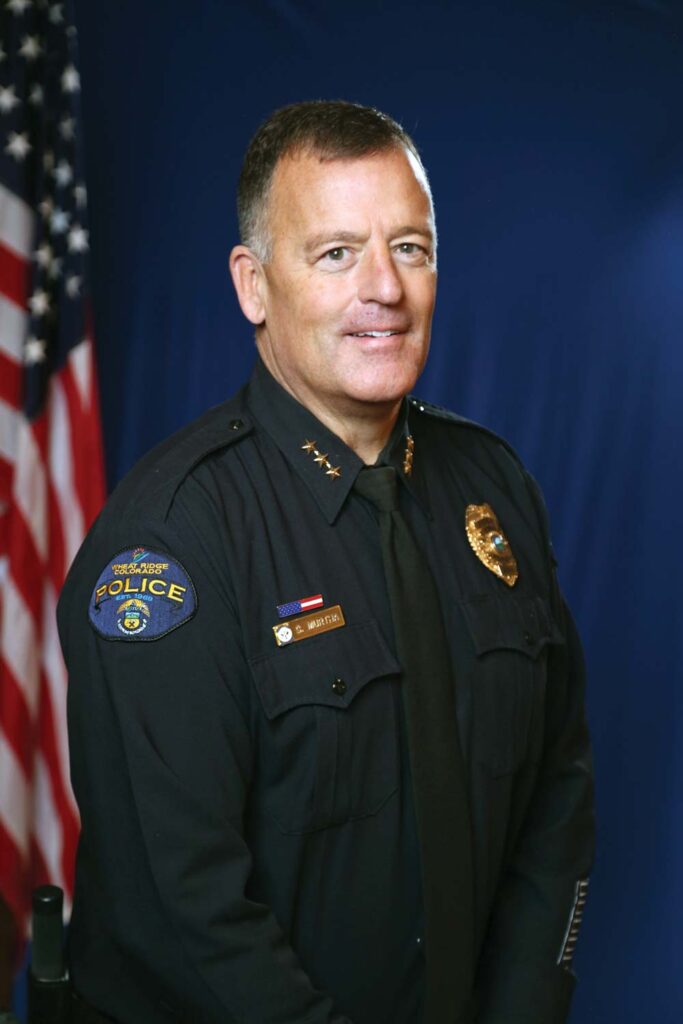
Now in his sixth year as chief of the Wheat Ridge Police Department, Chief Christopher Murtha reflects on changing crime trends from the height of the pandemic to today. With the help of new technologies and the largest graduating class of police officers in the department’s history, the police force can focus more on proactive policing and community engagement.
Using crime data from 2021 through 2025, there has been an overall 35 percent decrease in crime in Wheat Ridge.
The department is also collecting data on the use of new technologies, including speed camera radar, which clocks vehicle speeds and issues citations without an officer needing to be on the scene. In June 2025, 4,183 citations were issued for speeding near Wheat Ridge High School. Since the implementation of speed camera radar, only 1,133 speeding citations were issued in May 2026.
“The speed camera radar is how we save from having difficult interactions with folks on the side of the road that could be dangerous for officers, dangerous for the violator, but it also creates opportunity for some negative interaction,” Murtha said.
Other new technologies utilized by the department come through the Jeffcom 911 center, of which the department was among the original founding members. The center uses state-of-the-art technology, including AI and robotic call answering, to gather information and intelligence before an officer arrives on a call. People can also submit reports online.
The increased use of new technologies allows officers to use their time in other ways.
“We are trying to use technology to leverage that time back,” Murtha said. “We’re really getting close to the point where we think we have the right balance of officer proactivity involving criminal behavior and officer productivity involving pure community engagement by going out and speaking to people, attending community events and being present for community organizations.”
The department’s community policing philosophy values relationship-based policing and compassion with boundaries.
“I think there’s a balance there,” Murtha said. “I think that while we would love to have every contact involve an officer, there are just times that it’s not convenient.”
People calling in crimes or receiving traffic violations may not be interacting with a person.
“We are still engaged with the community at levels that are above what we would be if we didn’t have this technology,” Murtha said. “However, some of the technology does feel a little bit distant to people because they’re not getting a citation directly from an officer.”
Murtha said some people are happy to receive a citation through the new technology systems because wait times have been reduced and they receive a civil violation instead of a ticket from an officer, which could carry points on their license or increase their insurance rates.
Murtha became Wheat Ridge police chief in 2020. If you had asked him when he first became chief what crimes kept him up at night, he might have listed catalytic converter theft. Through the efforts of state resources and metro task forces, which focused on the groups stealing catalytic converters to sell for a profit, thefts of these parts have become much more manageable.
The number of stolen packages reported has also decreased during his time as chief.
“I do worry, though, that folks have just accepted that as part of life, which would be unfortunate,” Murtha said.
Crimes like drinking and driving do continue to keep him up at night.
“That one bothers me substantially,” Murtha said.
It’s less about playing the role of cops and robbers for Murtha, who works to ensure the police department implements policing that reflects the values of the community. While technology has helped reduce some offenses and frees up officers’ time, crimes against persons remain much more difficult to prevent. Murtha hopes the department’s emphasis on community outreach and proactive relationship building can help reduce those crimes.