


Wheat Ridge police have declared a traffic camera program a success after eight months and plan to expand it in the new year.
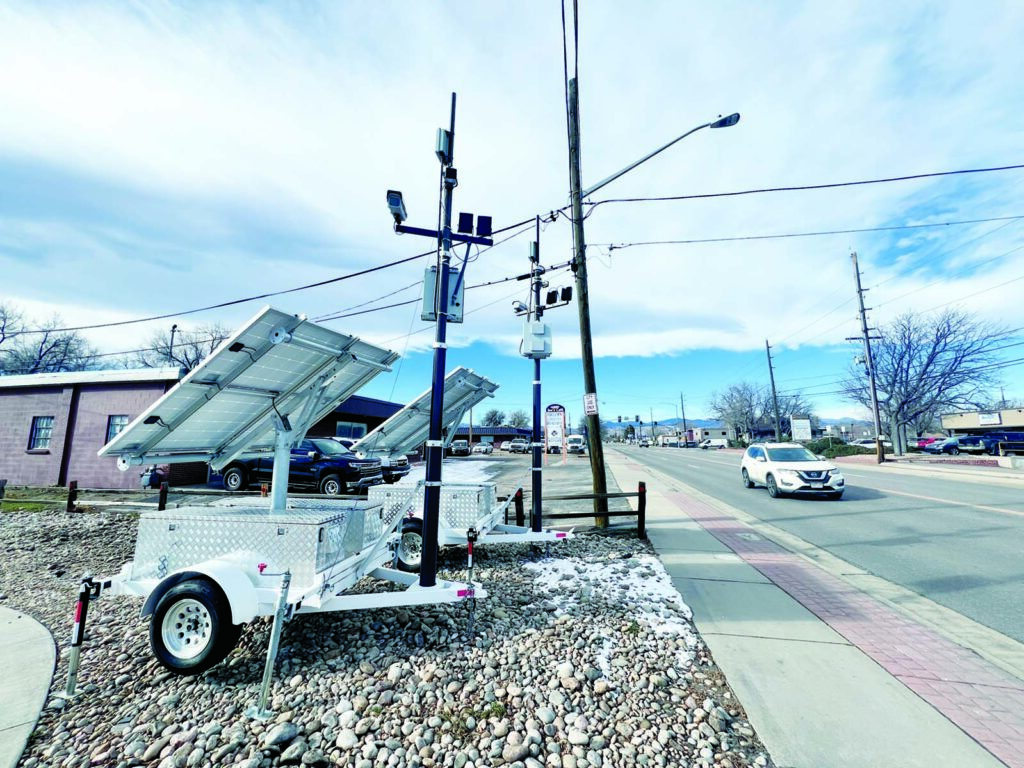
In April, solar-powered automated speed camera trailers were placed at West 32nd Avenue and Independence Court (Wheat Ridge High School) and West 44th Avenue and Field Street (Anderson Park).
A series of videos and photographs document each vehicle traveling at or above the speed limit. The date, time, location, speed and vehicle license plates are recorded.
The registered owners of violating vehicles are mailed $40 fines, along with photos and vehicle speed. Fines in school zones are $80 between 7 a.m. and 5 p.m.
‘Significant reduction’ in speeding credited to cameras
Police Department Public Information Officer Alex Rose said the cameras have “acted as a successful deterrent, showing fewer people are excessively speeding in these areas.”
When comparing the first three months of the program (May-July) to the following three months (August-October), roughly 30% fewer speeding citations were issued, Rose added.
Rose agreed part of the decline might be attributable to fewer vehicles during the later time period.
Rose noted the program’s 24,304 citations helped lead to “a significant reduction in excessive speeding in these areas.”
In June, 878 citations were sent for the Anderson Park location, compared to 483 in December, a 45% reduction. For the same period, the program sent 4,183 citations from the high school location in June, compared to 1,572 in December, a 62% drop.
Fewer citations also mean the department changed driver behavior, Rose added.
“We’re not trying to blind side anyone,” he said. “We’re being transparent about where the cameras are, the number of citations and the revenue we receive.”
As of January, the program generated roughly $208,000 for the city’s general fund, Rose noted.
He also explained a services agreement with Altumint — the company that provides the cameras, hardware and software for the program and processes the citation payments — allows Altumint to keep about 33% of the fine money. That works out to about $15 out of every $40 citation, he added.
Altumint began operating in 2005 and is Maryland-based with a processing center in California. Rose was unaware if there are any Colorado-based companies that offer the same services.
The city considered starting a camera program without a contractor, he added, but ultimately decided a contractor would be a better route due to the initial cost of the cameras and other hardware, software, etc.
Altumint was among five companies the city considered and Rose said they were chosen because of their technology and attention to the city’s questions and needs. The city leases the camera systems from Altumint, so they are responsible for any repairs, Rose added.
Agreement states no other money involved
On Oct. 28, 2024, the city council approved a five-year service agreement with Altumint with annual renewals afterward.
“No dedicated city funding is required…,” a council memo reads.
The agreement lists the lease of two fixed cameras ($8,990), two trailer-mounted cameras ($12,990) and a hand-held camera ($1,995) for a total of slightly less than $24,000. The one-time lease payment is paid with fine money.
Fees may be increased at the end of each contract year by the lesser of 3% or the increase in the consumer price index over the preceding 18 months.
‘Sloppy notice’ leads to fine dismissal
Former city council member Zach Urban received a fine notice last fall with printing mistakes that made most of the notice unreadable, he told the Gazette in a late January interview. Urban also wrote about his experience in a letter to the editor in the Gazette’s January issue.
Urban said he appealed the fine and mailed a letter to Altumint’s California post office box. He received a response that said they had not received an appeal letter and claimed he was delinquent in paying the fine.
“I filed a public records request with the city to get information about how the cameras were calibrated so they correctly record the speeds,” Urban said.
The city responded and Urban said his fine was dismissed by an appeals hearing judge.
“My main issue was with the sloppy notice and making sure everything worked correctly in how the system is managed,” he added. “I wanted to stress test the process and not take any of the city staff to task.”
So far, only a few citations have had to be sent to collections, Rose noted.
“It’s barely in double digits,” he said. “We might have more sent to collections once we scale up the program this year.”
The city has also waived some fines for valid reasons, such as late mailings, Rose stated.
Rose added since fines are considered “notices of civil violation,” owners are not assessed points against a driver’s license.
He explained each violation is reviewed by a city police officer before it is mailed. The officer (who testifies in appeals hearings) signs a statement that the vehicle’s operation violated the law, based on the recorded images.
Many comments and responses to department Facebook posts about the program were critical, calling it a “scam,” “not enforceable,” and an example of “lazy policing,” among other negative descriptions.
While Rose noted the department is fully staffed with officers, the department could not station them at all traffic light intersections without detracting from other duties.
“Technology does this work 24/7/365,” he said.
Rose called the camera system a “force multiplier” — it allows officers to handle more calls — but said it does not reduce the need for patrol officers.
“Despite the fact we are fully staffed, our officers respond to more calls per shift than the average cop in the Denver metro area,” Rose added. “Our call volume per capita remains very high.”
The department has a driver identification system, but Rose said it is not used with the speed cameras. It is more often used to help track potential criminals, such as when robberies occur, he added.
Expansion to include first red-light camera
By the end of January, two new speed cameras and the city’s first red-light camera were to be installed. Another camera was to be moved to a different site on the same street.
Rose explained speed cameras use radar to determine a vehicle’s speed as it drives away. Red-light cameras use radar and artificial intelligence to determine if vehicles come to a full stop before the light turns red.
The red-light camera will be at West 44th Avenue and Kipling Street. Running a red light at that intersection will cost $75, Rose said.
The Anderson Park speed camera will relocate further east on West 44th, near Hopper Hollow Park. New speed cameras were planned for Prospect Park on West 44th and the intersection of West 38th Avenue and Kipling.
Rose also noted the city’s designation of Kipling as a speed corridor allows officers to use a mobile version of the speed cameras along the street.