

Since high school, there has never been a time when Corey Wadley has not been building a guitar.
His first luthier work began when his parents bought him a cheap guitar from the local musical instrument store. His mom asked him not to take it apart.
“I took everything apart,” Wadley said. “I took it apart anyway, and I was able to get it back together, which was great. It started there.”
While taking shop class in high school with a permissive teacher, Wadley enjoyed pretty much free rein over all the shop tools.
After high school, Wadley joined the Army and even built a couple of woodshops while in the service. The early guitars Wadley built used parts of existing guitars constructed together to make new instruments.
While attending language school for Arabic at Presidio, there was a woodshop at nearby Fort Ord. They allowed him to build instruments there. He even promised the bass player in his band at the time that he would build him a new bass guitar if he happened to smash his on stage. He fulfilled his promise.
“I’ve always found a way, one way or the other,” Wadley said.
After leaving the service, Wadley took a factory job manufacturing instruments in San Francisco, California, first as a shipper and receiver, then working his way up through jobs in the shop and eventually becoming foreman.
Wadley worked for Chandler Guitars, where he made instruments for members of The Allman Brothers and Pantera. Working for big names wasn’t always easy because he had to deal with the musicians’ handlers, who are “paid to crack the whip and get things done,” he said.
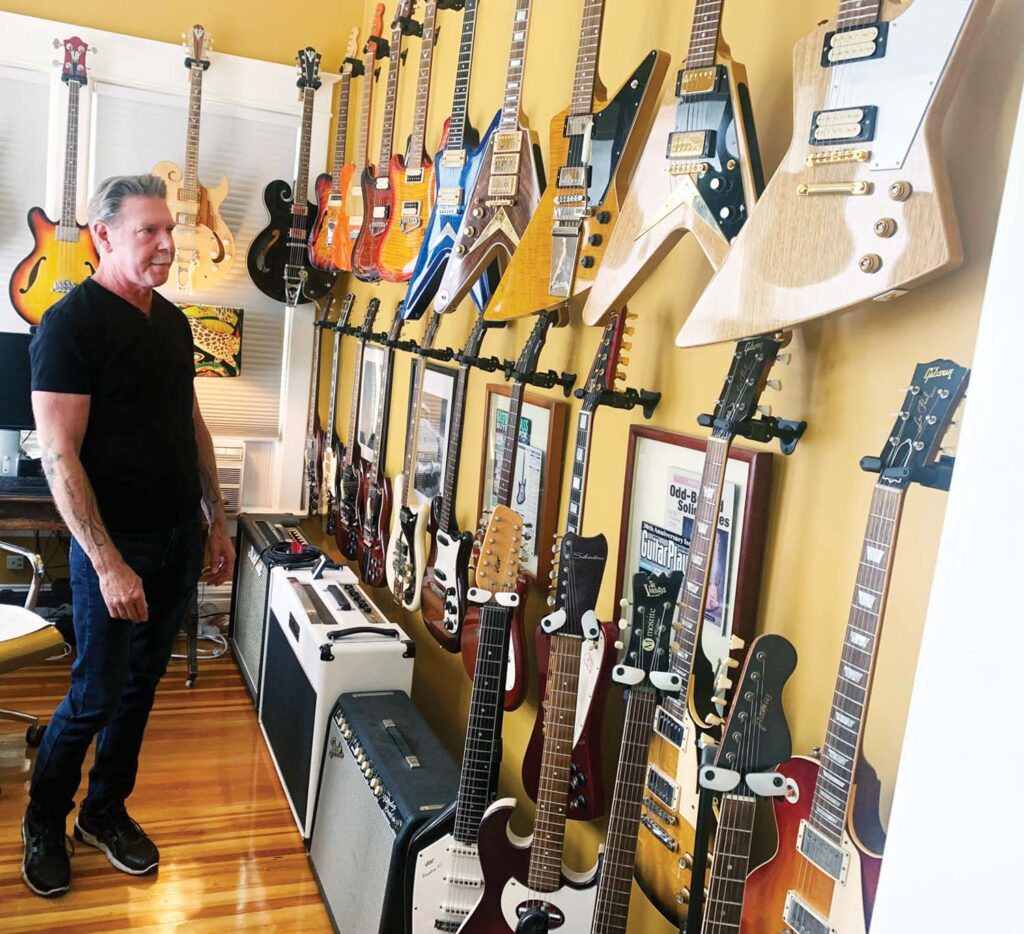
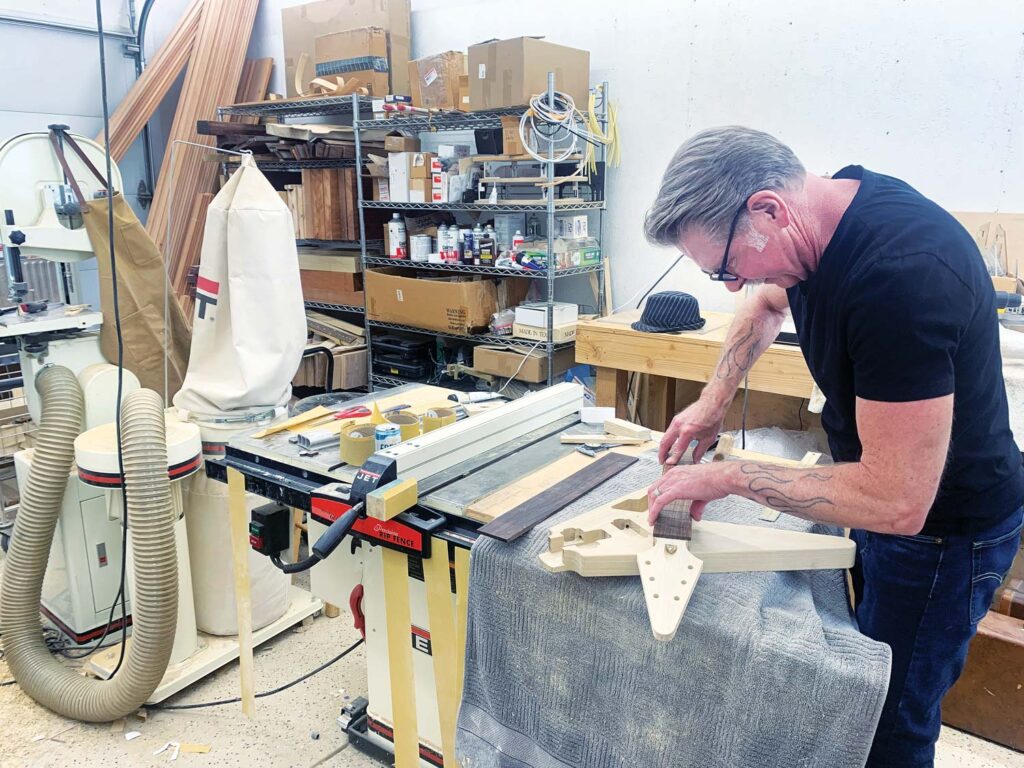
Wadley worked at Guitar Center for many years as a general manager but kept guitar making in the background. He has always had a shop, sometimes in a basement, a garage, below a pizza parlor or in a rented room in a Victorian mansion. Sometimes he tracked down his tools across town after someone stole them. Now, his shop is in his garage. He piles up his cars on lifts to give himself space for a shop.
When Wadley became a real estate professional, he started his own luthier business, V16 Guitars. He averages making about five or six guitars a year. He doesn’t have much more time than that. Each guitar takes about 80 to 100 hours to build.
His early advertising involved playing live gigs with the instruments he built. It became difficult to both play and build instruments, so he recently gave up playing music. But he’s most fulfilled when he’s making instruments. He now advertises his instruments on Facebook and Instagram.
He builds all his instruments from scratch and sources everything within the country. It’s important to him to support American jobs, and he has found the “made in the U.S.A.” label to be important to his buyers.
Wadley assembles his own electronics as well. The pickups in the guitars are also made by him. He also sells individual pickups. He can hear the difference in guitars that have his electronics inside.
“I think the only way to control your own tone is by controlling the electronics,” Wadley said.
His recent full-build guitar projects include reclaiming wood from two slide guitars from the ’50s to use on new guitars. He specializes in using Korina wood, which is also called white limba. Gibson renamed it in the 1950s so that its competitor, Fender, wouldn’t know what they were using.
Wadley mostly receives orders for guitar models that already exist. Someday, he would like to experiment more with new designs, but he knows that musicians can be slow to warm to new design ideas. It generally takes years for guitar trends to catch on.
“I’ve been in the retail side of it long enough to know that when new things come out, it’s hard,” Wadley said. “It might take years for it to ever catch on. That company may have already gone out of business before it ever catches on.”
Some guitar designs that are popular now were unpopular when they first came out in the 1950s. Once the guitars became more available on the used market, or musicians like Jimi Hendrix or Eric Clapton started to pick them up, they gained a bit more traction.
One highlight of building his own guitars at V16 was a partnership his daughter started through a social media message with her favorite band at the time, Black Rebel Motorcycle Club. He built multiple instruments for them and got to hear his instruments played at shows.
As for the future, Wadley hopes to continue building guitars. If he ever had more time in his schedule, he is considering opening a small factory and hiring employees. But for now, he’s enjoying the simplicity of working for himself.
“If it’s just me, there’s no failure,” Wadley said. “I could do this forever.”
Guitar making continues to be what he calls his “sanity sidebar.”
He works on contracts for a local real estate group. When he wants to use his hands, he shifts to guitar making. From geometry to woodworking skills, he enjoys that there’s a little bit of everything involved in making his guitars.